“Dispatch, Please Advise!”
Tactics for Fighting the Federal Occupation of Minnesota by ICE
by the Red-Winged Blackbird collective (Minnesota, USA)
First circulated 22 January 2026 (PDF)

Introduction
“Settle your quarrels, come together, understand the reality of our situation, understand that fascism is already here, that people are already dying who could be saved, that generations more will live poor butchered half-lives if you fail to act. Do what must be done, discover your humanity and your love in revolution.”
—George Jackson
This is the first statement from Red-Winged Blackbird, a socialist publication in Minnesota. Our contributors engage in mass work and direct action that builds working-class power to destroy the capitalist-imperialist system; since December, we have joined thousands of our neighbors in being on the ground and in the streets, resisting ICE. We believe that the people have the power within ourselves to bring about revolutionary change, and we aim to build that collective belief among ordinary working people. This moment testifies to that revolutionary possibility. We wrote the following statement for three reasons:
- To synthesize our work during the ongoing 2025—2026 federal occupation of Minnesota, known as “Operation Metro Surge.”
- To experiment with our neighbors and comrades on what to do in this moment and in the future.
- To create a guide for other cities which will face the brutality of the federal government in the months and years to come.
This moment is incomprehensible and horrific. Everyday life for immigrants, both documented and undocumented, is defined by fear and violence. Murderers like Jonathan Ross are allowed to walk free. As revolutionaries, we have an obligation: not to stop feeling, but to continue thinking. This means we must build the power, capacity, and consciousness of the working class to emerge from this moment stronger, more organized, and better prepared for the next crisis.
For our comrades in other states and cities: what we are doing in the Twin Cities works. This isn’t to say that we are winning—how can we when so many have already been abducted, murdered, and disappeared?—but internal memos leaking out of DHS tell us that our rapid response networks have shaken ICE’s confidence. As ICE spokesman Gregory Bovino said, “What we’ve seen that’s different here is…the groups are better organized. They’ve got some excellent communications.” Federal agents say they “just don’t want to go” to Minnesota.
We have witnessed many successful efforts by Minnesotans to stop and slow abductions, but it has not been enough. What would be enough? Using our community’s networks and collective brilliance to bring about the end of ICE’s operations, all the while engaging in a long-term process of building working-class power in Minnesota.
What follows are descriptions of four tactics we believe are essential to resist the state in this moment as we build towards socialism and the abolition of ICE, borders, prisons, and racial capitalism. These tactics are:
- ICE-Watch: Commuting (in cars) and patrolling (on foot), to minimize ICE’s power to terrorize and abduct our neighbors, and to confront them when they do.
- Build the Block Committees: Creating and strengthening neighborhood associations that move us toward the long-term goal of mass democratic control of the places we live, as well as the immediate goal of keeping each other safe.
- Flashpoints: Direct confrontations between the feds and the people.
- General Strike: Moving our workplaces towards shutdowns and eventual participation in a long-lasting, city-wide general strike.
1. ICE-Watch
What does it mean to watch ICE?
A wide range of people around Minnesota have engaged in the practice of following and monitoring ICE activity. This can be done on foot and or in a car. Sometimes this also means showing up immediately to the scene where an abduction is taking place, which is called rapid response.
Why follow ICE?
Our goals when following ICE are to:
- Throw ICE off their course, waste their time, and force them to drive away.
- Alert at-risk people to ICE presence.
- Make the whole neighborhood aware of ICE presence to get them outside and resisting.
- Escalate at ICE abductions and create potential flashpoints.
What are best practices for observing ICE?
- Don’t go out alone. This creates (relative) safety in numbers and allows you to split up roles between people.
- Make sure someone knows what you’re doing. Make a jail support plan, check in with yourself and your buddy to make sure you’re prepared for what risks you are willing to take, and make sure that you have everything you need with you, including first aid and personal protective equipment (PPE) in the event of ICE’s weapons being used against you.
- Start in a small area that you know well. You can then respond to ICE quickly when they enter your patrol radius.
- Join or start a call on your neighborhood Signal chat, or stay up to date with local rapid response networks. Crowdsourcing information about ICE will make you more effective at tracking their movements and will increase the likelihood that many people will quickly respond to attempted abductions. Be collaborative, but remember that the dispatchers and other members of these chats are not there to make decisions for you. Be in touch with your own risk assessment and make the decisions you feel are most strategic for you.
- Provide accurate information about ICE presence using SALUTE messages and the NATO phonetic alphabet. SALUTE—Size, Activity, Location, Uniform, Time, and Equipment—allows detailed information about law enforcement activity to be sent into chats. The NATO phonetic alphabet allows people to read off the license plates of confirmed or suspected ICE vehicles to other people on the call without being misunderstood.
- Honk your horn and blow your whistle! This serves the dual function of letting vulnerable people know that ICE is in the area and intimidating ICE by making their presence known to passersby and others primed to resist them. Making noise in the presence of ICE slows them down, whether they’re getting gas or abducting someone.
- Trust context clues more than you trust “plate checking” (referencing databases of known or suspected ICE vehicle license plates, which are crowdsourced and non-definitive). ICE disguises themselves and adopts new tactics on a daily basis. Stay vigilant and develop your own sense of what ICE’s behaviors look like. You’ll get better at identifying them the more that you do it.
What are the risks of following ICE? How can you mitigate those risks?
Any time you go out to watch ICE you are putting yourself at risk. That choice is yours to make. Following the best practices above can help you minimize that risk. Always ICE-watch with one or more comrades. Check in with them in advance about your shared risk level and your emergency plan.
What do you need in order to watch ICE?
- A phone (disable biometrics and bluetooth, and set a 12+ digit alphanumeric passcode) and a charger
- A mask or face covering
- An ID
- Any medications you take in their original container
- Weather-appropriate clothing
- Food and water
- Whistle, megaphone, or bullhorn
How should you handle law enforcement interactions while watching ICE?
Never speak to law enforcement and never give a statement.
If you are stopped or detained by ICE while monitoring their activity, you have no legal obligation to interact with them or provide them with any identification if you are a US citizen. In Minneapolis, we have found that citizen observers have mostly been released quickly and without charges after being detained by ICE.
If you are stopped or detained by other law enforcement while observing ICE, you must present ID if you are operating a motor vehicle. They may detain you for longer periods of time. It is worth noting that across the country, several instances of trumped-up charges faced by observers have been dropped, because observing is, for the most part, a perfectly lawful activity.
How can you get others to join in?
Host trainings for trusted people in your networks using this information! We have found it to be effective to host hour-long presentations virtually with accompanying slideshows for our roommates, neighbors, coworkers, friends, and other people we’ve encountered in this movement. Create spaces for people to meet one another and form affinity groups to observe ICE with.
2. Build the Block Committees
What are Block Committees?
As neighbors, we have an obligation to keep each other safe and cared for. We can start building powerful networks by meeting our neighbors through doorknocking, face-to-face interactions, and organic social connections. At the smallest possible level, we can build Block Committees—organized groups of people who live on the same block and share the same goals. A Tenants’ Union is a similar formation involving people living under the same landlord. As Block Committees and Tenants’ Unions grow, they can merge into larger-scale Neighborhood Assemblies, which could theoretically merge into a city-wide General Assembly. In the Whittier neighborhood, for example, a Neighborhood Assembly was called in January, and 1,000 people showed up. Speeches were made, soup was served, and everyone broke into small groups by the blocks they lived on. This was a monumental step in the self-organization and defense of the Whittier neighborhood.
All the groups listed above exist to:
- Defend vulnerable neighbors who are under attack. They can organize patrols, distribute supplies like whistles and hand warmers, and ensure vulnerable families have food and housing. They can also force landlords to repair busted doors so ICE can’t get in and post notices saying that ICE is not allowed on the property.
- Build long-term structures of direct democracy in our neighborhoods. These networks can serve as hubs for future organizing and as key building blocks when the next crisis comes. Organize your own block, and connect with others. Convene assemblies to learn from each other and further coordinate your resistance.
These neighborhood organizations aim to increase the safety, dignity, and belonging of all working-class people. Neighborhood Networks can engage in community defense, organize local mutual aid, and build the power of tenants across the city.
- SAFETY: The US state fails to keep us safe. Just as many of our neighbors fear being abducted by ICE, we and others face ongoing vulnerabilities such as food insecurity, housing insecurity, job insecurity, lack of medical care, lack of childcare, and general inadequacy of living conditions. The state will not fill these gaps, so we as neighbors must come together and do so. Neighbors can help each other by pooling resources towards groceries, medical care, defense against attacks, and more.
- DIGNITY: Everyone has the right to dignified housing. However, we know that “rights are what you make and what you are organized to take.” Working together in the struggle against landlords and generalized conditions of poverty is the only way to make sure everyone has the housing conditions that they deserve. Specifically, neighbors can organize for lower rent, adequate repairs, and to stop evictions.
- BELONGING: In these times of occupation and escalated federal repression, we can foster a sense of belonging by sharing resources and skills. In times of relative calm, it is also our responsibility to build a sense of true community in our neighborhoods. By getting to know our people, helping them out when we can, and asking them to give back, we can establish deep trust and prove that we will have each other’s backs.Perhaps someday soon, a neighborhood network could proactively set up a blockade of their own block—only letting local traffic through. ICE wouldn’t be allowed to pass from the get-go. This could go hand-in-hand with routine supply drops, check-ins on our most vulnerable neighbors, and empowered democratic discussions and decisions about how best to use the resources of the area. If we can dream it, we can do it.
How do you form a Tenants’ Union?
Start with neighbors in your building (those who have the same landlord). Reach out to those you already know and doorknock those you don’t. Create a group chat, start meeting regularly, and form a Tenants’ Union. Learn each other’s needs and act together to get them met. This will both require and prepare you to make demands of your landlord that could actually be won.
How do you form a Block Committee?
Make a plan to doorknock other buildings on your block with your people. Encourage others on your block to form Tenants’ Unions. Talk about your collective needs and resources and how to share these amongst yourself. A Block Committee is an important level on which to challenge ICE. If everyone on the block is well-connected enough to each other, they’ll know exactly how to respond if/when ICE shows up. Get on the same page about protocols and find out what each person’s role is. Start holding meetings to get to know each other and have regular check-ins.
How do you form a Neighborhood Assembly?
Start looping in neighboring blocks. Leverage and deepen other connections with people you know who live in your neighborhood and make plans with them to organize their neighbors and blocks. Meet regularly as a Neighborhood Assembly: many Block Associations all coming together as a neighborhood. Coordinate keeping your neighborhood safe (including a detailed ICE-response plan), organize mutual aid within your neighborhood, and support each other in asserting your right as tenants. Work together to make your neighborhood stronger.
How do you form a General Assembly?
Get in touch with other Neighborhood Assemblies. Send representatives from each Neighborhood Assembly to report back on strategies and tactics that have been successful, and areas where more coordination and resource sharing is needed. Build democracy through active participation, discussion, and communal goal-setting. In Minneapolis, the General Assembly level of organization is mostly theoretical at this point, though that might change very soon.
3. Flashpoints
What is a flashpoint?
Flashpoints are specific times and places where a crisis quickly and dramatically escalates. When we say “flashpoint,” we mean any time and place where masses of people are directly confronting the armed force of the state.
There are several places across the Twin Cities metro that already have, or could in the future, escalate into larger, more sustained confrontations. Another murder, a prolonged and escalating abduction attempt, fascist civilians escalating violently, or mass protests that spill out into an escalated confrontation with the state are all potential situations that could lead to flashpoints. These possibilities are dangerous, but they are also sites at which we can escalate our resistance and inspire people into taking more militant, organized action. We need to be prepared for these moments, we need to keep each other safe, and we need to be able to escalate when it is strategic.
We think there are a few places we should be prioritizing to best achieve these goals:
- Hotels where ICE agents are staying. They are at their most vulnerable at these hotels, and a strong campaign could reduce their ability to stay functional. So far, most hotel actions have been noise demos. Potential next steps could include daily/nightly pickets, occupying lobbies, and blockading cars in or out. This has worked at several junctures during our current occupation wherein ICE have moved to hotels farther out of the city after being disturbed by noise demos. Pressure campaigns have also forced some hotels to cancel ICE’s reservations or shut down temporarily.
- The Whipple Federal Building, which is the current headquarters for ICE operations. It is an unideal location for direct action because of its sprawling nature, inaccessibility, and proximity to the airport, National Guard bases, and the Mississippi River. Protesters there can easily get boxed in or kettled. Still, Whipple is the primary place from which ICE agents go out into the streets, and it’s where they bring detainees to be processed. If we can create an effective disruption—which would likely require thousands of participants—the potential impact on ICE’s ability to operate is very high.
- Areas where ICE stages to abduct people, which have often been in parking lots, outside homes in immigrant neighborhoods, and on main streets such as Lake, Bloomington, Portland, and Nicollet, where there are many immigrant businesses and where working people often take the bus to commute to work.
- A Note on 34th and Portland, the site of Renee Good’s murder by ICE: For several days after the murder, this block was blockaded and turned into a site of mourning, mutual aid, and community gathering. Comrades distributed food and supplies and stayed warm around fires; they also created barricades that closed off 33rd and 34th on Portland, including its cross streets, and created a civilian checkpoint that allowed neighbors to move their cars when needed but did not allow ICE, law enforcement, or unfriendly agitators inside. The cops raided and destroyed the barricades at 4am. Now that the street is open to traffic again, protesters and mourners are confined to a small section of the street. Constant police presence has made it harder to make it the place of grieving it should be, yet mourners still gather there daily. Our question is less whether 34th and Portland should be re-blockaded, and more whether the memory of the autonomous zone there can be used to inspire more anti-ICE blockades elsewhere.
What should you do to prepare for a flashpoint?
Have good personal safety and security protocols, and work with trusted comrades.
- Bring respirators, water bottles, goggles, and gloves if you are knowingly going into a likely escalated situation. ICE has been shooting pepper balls, deploying tear gas, pepper spray, and flash-bang grenades, and have used their tasers and guns on multiple occasions.
- Create a 12+ digit alphanumeric password and disable biometrics on your phone (especially face ID). Turn off location services. Turn off bluetooth. Set your phone to wipe its data after 10 failed sign-in attempts. Consider bringing an ID (definitely if you’re driving), but maybe not your whole wallet.
- Form an Affinity Group (AG). AGs are small (3-10) groups of people with similar tactical and risk assessments and a lot of trust who take strategic and principled action together. AGs should discuss and make plans for jail support and share their emergency contact information with one another or a highly trusted person outside the AG.
What are tips for thinking strategically during a potential flashpoint?
- Assess the situation. How many opps (opponents) are present? This includes the overall number of cops, federal agents, and fascists. What kinds of equipment do they have—vehicles, weapons, tear gas canisters, riot gear, etc? How many “friends” are present? This includes the overall number of people you think are willing to assist with the task at hand. What sorts of equipment do you have? How many “neutrals” are present? This includes general witnesses, people there but who seem unwilling to be involved, people from the media with cameras and microphones, passersby, those who live in the area, and others. Where are your easiest exit points?
- Determine the goal. Is the goal to stop an abduction, de-arrest someone/multiple individuals, create a blockade to prevent opps from coming or going, push back on the creation of a boundary, or something else? Consider what it will take to accomplish the chosen goal, and whether the rest of your present AG is on board with said goal. Is it achievable based on who is present?
- Accept or reject the task at hand. In the moment, you might sometimes move first and ask questions later, but it’s important to communicate with each member of your AG before you make a decision that impacts everyone. Whenever possible, try to determine your next steps collectively.
- No action without reflection. After the fact, discuss and review. Did you accomplish your goal? If so, which factors were working in your favor? If not, what could’ve helped? Additionally, what harm was done? Does anyone need medical attention, jail support, or any other type of aftercare?
Remember, always, to take care of one another. We’re all that we have.
4. General Strike
Why strike during the occupation?
“Business as usual” during the occupation benefits the US capitalist state. We refuse to pretend that society can continue “normally” while our neighbors are being disappeared. Furthermore, workplaces (and commutes there) are often where ICE abductions actually occur, making the act of going to work extremely unsafe for undocumented people during a federal occupation.
As workers, we make society run. Society is produced and reproduced by our labor. The occupation makes this impossible. We are being forced to live and work alongside lawless killers. Workers fear kidnappings on their daily commutes; children fear that if they leave for school their family won’t be there when they return home. Those who work at car rentals are forced to rent vehicles to ICE agents; those who work at a gas station or restaurant are forced to serve them.
Collectively, and whenever possible, we must refuse to cooperate with all this. We believe that one of our greatest tactics against not only the current federal occupation, but also against the capitalist system as a whole, is to withhold our labor. Historically, large-scale strikes are one of the most reliable ways that the people can force the government to concede to their demands (or to topple the government entirely). Together with our coworkers, families, neighbors, and union siblings, we must build toward a long-term general strike.
What should the strike’s demands be?
The main demand of a general strike right now must be to drive ICE out of Minnesota and to abolish ICE. Secondary demands should include measures to keep vulnerable workers safe from ICE—banning ICE from workplaces, homes, and other properties, a citywide moratorium on evictions, etc. Further demands could include any and all ordinary workplace demands that would increase the safety, dignity, and belonging of all workers.
How do you educate and agitate your neighbors and coworkers about the need for a general strike?
Talk to your neighbors and your coworkers, starting with the people you can trust. Tell them that the checkpoints will continue, the abductions will continue, and the suffering will continue, until we stop ICE—and we can stop ICE. We have to create a crisis for ICE that is even bigger than the one it created for us. Let trash pile up while the trash collectors protest in the streets. Force transportation and commerce to a halt. Let the malls, offices, schools, stores, and construction sites lie empty. We must force the capitalist system to grind to a halt.
A general strike is not an easy thing, and nobody can organize one on their own. Your part is to identify your terrain and your people and act accordingly. Organize your block and your workplace around the idea that nobody should work until the occupation ends.
Are you already part of a union?
It’s important to put pressure on union officials to take action. At the same time, we don’t have to listen to them if they don’t want to take action. We must build rank-and-file networks of workers interested in planning and acting on their own initiative; raising the possibility of more militant action and bringing more coworkers into the conversation can accomplish this. In this moment in the US, union officials are generally wary of participating in social movements beyond the narrow interests of their unions—it is only when union members demand action, and the political crisis becomes too great to ignore, that union officials step up. The strength of the rank-and-file is decisive in initiating and maintaining the union’s promises and commitments during social movement flashpoints.
Have conversations. These can happen 1-on-1, around the table at the break room, at the union hall member meeting, and in newly formed Signal chats. Just declaring the intention for a general strike in these discussions won’t accomplish much; rather, raise a series of questions that highlight the nature of the present situation, starting with where you think your audience is at and talking with them step-by-step about what you both want to see happen, and how you’re going to make that happen.
Good starting questions could include: “The union rally was maybe a good first step, but I don’t see how that’s going to change anything on its own. What would make a bigger impact?”
And, ”For ICE to terrorize and kidnap, they’re dependent on the rest of society living in fear and going about their lives as if everything is normal. How do we disrupt the conditions that make it easy for ICE to operate?”
And, ”Did you hear how the high school students walked out?”
It’s important to note that we should not wait for a general strike to take action, nor should we discourage the militancy of others. Workers and students most affected by repression and state violence can and should conduct their own work stoppages, walkouts, and other types of direct action and sabotage as their situations develop. It is our role as members of the working class to show up in solidarity at these actions and defend our comrades, neighbors, and community members that take such action—and to keep pushing things forward toward the general strike.
Are you striking without a union?
Start by talking to those you know you can trust. Share this document with them. Have a meeting. Make a plan. Who will talk to whom? Write down a list. What is your plan to confront your managers when they say you can’t go out? In Minneapolis, we’ve already seen workers force their workplaces to close so that they can go march in the streets.
Reflect together afterwards. How did things go? Are you on track for your original plans? What’s working, and what isn’t? Onboard new members, make adjustments, and continue. Figure out what you don’t have that you need—like money, for instance, to cover missed wages—and figure out how you’re going to address those gaps. Get creative: can you get an eviction moratorium passed in your city? Would that extend your strike? Can you collect sick pay? What about childcare? Are there sympathetic elders you can bring in? How about students?
A Final Note on Federal Repression:
Minnesota, and Minneapolis in particular, has a storied history of struggle against fascism. While ICE is in many ways similar to the Gestapo, that comparison obscures a deeper and more dangerous truth. ICE is not a foreign import of European fascism, grafted onto the United States—it is a distinctly American institution. ICE itself was only founded in 2003, but it is part of a long history of American fascism, from the genocide of Indigenous people, chattel slavery, and Jim Crow, to the fascist tendencies of Henry Ford and other mythologized American leaders. The ICE agent is the slave catcher modernized, a contemporary evolution of a homegrown apparatus of racial terror.
None of this is new. And yet the current chapter of state repression, ushered in by the second Trump administration, may very well have implications of an unprecedented scale, because the technology and machinery at the feds’ disposal have never been so powerful.
The struggle against governmental repression has expanded and mutated since the George Floyd Uprisings of May 2020. Minnesota, like the rest of the country, has been living through the carefully planned, wildly over-budgeted militarization of all armed forces—tools the government is ready to weaponize against the people at any time. But there is a marked difference between the authority of local police units and the forced, reactionary authority of the federal agents carrying out Operation Metro Surge. ICE is an untrained fascist militia roaming our streets. They will throw around whatever resources they have, but—for now—that does not include generalized legal authority over the public.
This is not to say that Jonathan Ross will be brought to justice, or that the law will intervene in time to save the thousands of people being taken from their homes and families. Rather, ICE knows they do not have broad power over citizens. When people turn out en masse, they cannot—legally or logistically—arrest all of us. Across the country, the federal government has struggled to make its trumped-up charges against observers stick, and support for ICE from police departments and even the National Guard has been inconsistent at best.
When people turn out, we do scare ICE off. We are effective. We cannot lose sight of the fact that organized people have power. We must heed the call to do what we can to keep our neighbors safe.
Under this distinctly American form of fascism, the stakes are life or death. But that does not mean we will allow our consent to be manufactured. We will not accept false authority. Let the world know that when the fascists come to town, we will run them out.
One of the tasks before us now is to spread this understanding to help renew faith in the power of the people.
Every day in the Twin Cities since the murder of Renee Nicole Good has been a heartbreaking but inspiring demonstration that we are strong and capable, that we love each other and our shared home, and that we will not stand for injustice.
Conclusion
As we write this, there are thousands of federal agents violently occupying so-called Minnesota. Despite this fact, we know that this moment will pass, because ICE eventually must leave Minnesota. This program contains our best ideas for how to survive this attack, but it also challenges us to think beyond it. What would it look like to protect your block with your neighbors all the time? What would it mean to share resources with your community all the time? How can working people organize ourselves so that we can not only survive, but flourish? Let this document be a tool in that long struggle.
In 1853, at the height of the power of American chattel slavery, while slave patrols and federal agents empowered by the Fugitive Slave Act brought the crisis into northern cities, the Black abolitionist Frederick Douglass remarked:
The conflict has been exciting, agitating, all-absorbing, and for the time being, putting all other tumults to silence. It must do this or it does nothing. If there is no struggle, there is no progress. Those who profess to favor freedom and yet depreciate agitation, are men who want crops without plowing up the ground, they want rain without thunder and lightning. They want the ocean without the awful roar of its many waters.
Twelve years later, slavery was abolished by a crashing wave of revolutionary struggle.
We won’t be the first to fight against oppression and win. All power to the people.
—Minneapolis, January 2026
Download and share this guide as a PDF:
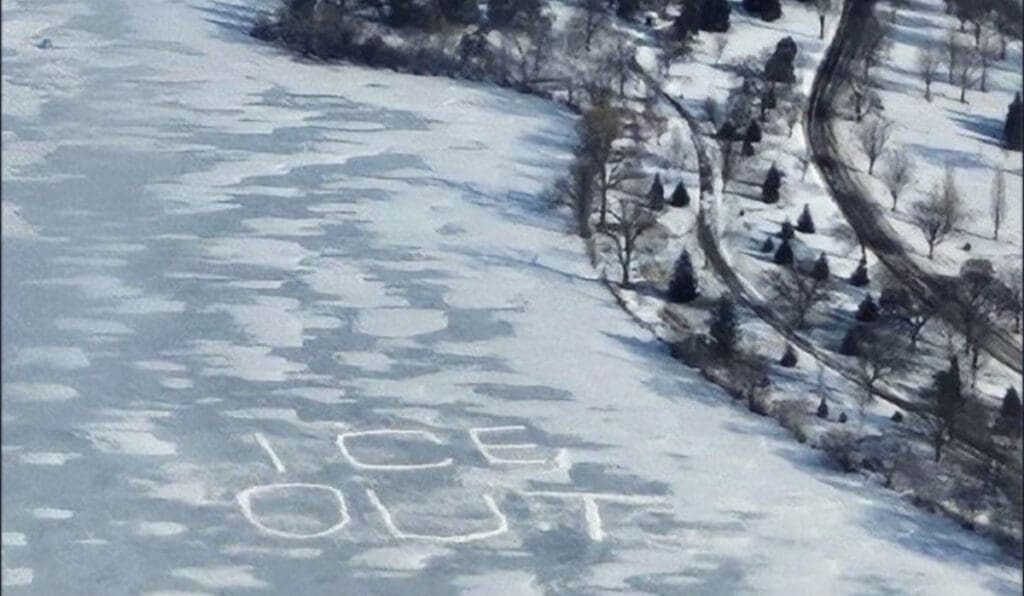
Featured image: Lake Nokomis in south Minneapolis as seen from a landing plane