Autonomous Kitchen Councils: Weaving Webs of Abundance
by the Autonomous Kitchen Councils Collective
PDF for reading | PDF for printing
Note: Web and print PDFs are being added to the end of this post for languages other than English. First up: Italiano (read | print)

Dedication
We dedicate this zine to my grandma Abundia Guia, my mother Guadalupe Alvarado, and countless Indigenous women leaders, organizers, cooks, and thinkers whose ideas and legacies colonial empires and capitalist systems have tried to erase. We also dedicate it to our beloved comrade Tortuguita, whose birthday we just celebrated, and to Alex Pretti, Renée Nicole Good, and all the great people of Minneapolis, who stand together with dignity and courage against ICE mobs and the fascist regime. May you always be remembered by your kin, may your voices resonate everywhere, may your stories and spells protect us in the hard times ahead. May your ideas and strategies for survival, care, and revolution illuminate our paths everywhere! May your recipes keep us nourished, connected, and strong for the upcoming struggles!

Why Kitchen Councilism & Autonomous Kitchen Councils now?
This zine is meant to be read and digested in community, around care, delicious foods, friends stories and recipies, neighbors and the ghosts of departed loved ones.
The Autonomous Kitchen Council (AKC) organizing framework was born out of collective heartache and pain. In February 2023, I was part of a small group of forest defenders that carried out the conversations we began during the early days of the Stop Cop City movement in Mvskoke homelands—so-called Atlanta, Georgia, USA—back in the late summer of 2022. We decided to write about these ongoing dialogues as a way to mourn and honor Tortuguita, a beloved Indigenous queer migrant comrade who was killed on January 18, 2023 by the Georgia state patrol, defending the forest they loved so deeply. They too were part of these conversations.
In early February 2023, we wrote a piece titled “Defending Abundance Everywhere: A call to every community from the Weelaunee forest.” The writing explored what we had learned from the forest and its abundance, from one another, and from the interconnections between abolition (as we came on the heels of the George Floyd uprising in Minneapolis and continue the fight for abolition of the police), racial justice, gentrification, land back, and systemic care—all grounded in the Stop Cop City struggle and the spaces of solidarity we opened in the forest. The piece was published by CrimethInc in March 2023.
By the spring of 2024, these conversations had spread outside so-called Atlanta, leading us to reimagine systemic care through the spaces we inhabit. At that time, most participants were 2Spirit, queer and trans women. We were worried about our safety and our futures, given the state of the country and the world. We wanted to organize not just for resistance, but also for our healing and joy. We also felt that, like many other marginalized groups, we had often been left out, our care and well-being compromised, and that the rallying cry “resist” needed a complementary word. As we reflected on the organizing structures, group dynamics, and inherited ways of living shaped by Abundance—especially by stateless people, migrants, and disenfranchised groups—new ways emerged of understanding care, safety, resources, organizing, power building, collective processes, and ultimately revolution.


It’s worth mentioning that people from many territories, identities, and experiences have contributed to create the AKC framework, with stateless, migrant, working-class, disabled, Indigenous and Black trans and cis women at the forefront.
Aymara Indigenous organizer Magali Vienca Copa Pabon, in an article for The Funambulist, writes: “For Aymara women, weaving means that the pace of change is different; women prepare revolutions in advance, sustain them, and care for them.” This quote sheds light on the path we want to follow as we open the possibilities of organizing from care spaces.
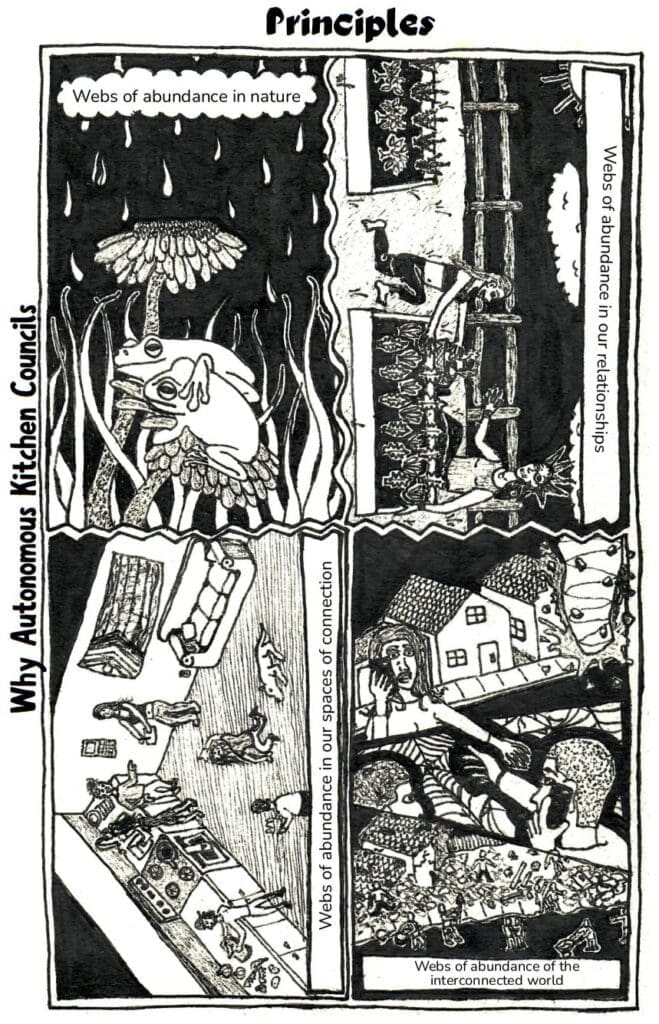
After two years of coming together to cook and share our stories, practices, and experiences of care, we were able to start to articulate a philosophy from our Sacred Webs of Abundance (SWoA), and four core organizing principles emerged. We believe these principles can greatly help any organizing efforts for care and revolution:
I. Flexible Structure
II. Rotation
III. Local Solidarity
IV. Sovereign Food Cultures
These four principles and the philosophy that sustain them will be explained in this zine from the context of our regional Sacred Webs of Abundance. This explanation is just a springboard for further community reflection, and doesn’t aim to be exhaustive or conclusive on the subject of our SWoA or the four organizing principles.


The goal of this zine is to familiarize you with the philosophy of Abundance, which is the foundation of our organizing framework, and with its four principles—and to support you while you interrogate with community what kitchen councilism and AKC spaces could look like for you.
We want this framework to be discussed everywhere and to make it accessible to everyone, not just our most privileged comrades from the rich North.
As the threats of extractivism, fascism, colonialism, and climate change intensify globally, and as our struggles increasingly intertwine, it is even more crucial to pay attention to organizing frameworks—old and emergent ones—that center historically disenfranchised communities, not as tokens or recipients of charity, but as active participants and leaders: stateless people, migrants, Black and Indigenous communities, the poor, trans and cis women, queer and disabled people.
But how can we start/continue these conversations?
How can we come to understand care as a key part of our revolutionary political projects, and move it away from the “private/personal” sphere?
How can we, for example, in the so-called USA where I live, use this frameworkp to create safe spaces for migrants under attack by ICE and police, right now?
How can it help to disrupt ICE kidnappings?

How can it help communities empower themselves for their own care and safety?
How can it help enhance security culture in any given space—relying less on tech and more on relations?
How can people cooking together grow, politically and in trust with each other?
How can it help us create power locally, regionally, and across territories?
These are just a few burning questions in my head. I passionately invite you to respond collectively to these and many other questions that will arise while interrogating this framework over a cookout, tortilla- or bread-making, or a potluck.
It is my belief that a framework centered around spaces, relations, and resources can help tackle common organizing issues such as burnout, disengagement, and power-grabbing, and help to abolish hierarchy and individualistic ways of existing and showing up in collective spaces. I also believe that the AKC framework could foster a deeper culture of connection as well as new ways to relate to land, each other, the spaces we are part of, and resources.
Last but not least, this zine is our invitation to you to consider becoming a Kitchen Councilist practitioner! We hope it inspires you to open spaces for conversations with friends, comrades, and neighbors on the ideas and questions we’re putting forward here, and that you get excited to build and strengthen systemic care and new strategies with those you organize and share life with, and to keep defending and celebrating your community spaces and local and regional Sacred Webs of Abundance.
Come join our “tanteo” while we cook, care for each other, and strategize together. Let’s collectively reimagine life, organizing, power, and revolution from the outskirts of the declining empire, anywhere you are, guided always by the power, resilience, and magic of our Sacred Webs of Abundance.
For Kitchen Councilist practitioners and AKC spaces everywhere,
Abundia

*Tantear: Verb. Infinitive tense, present indicative. Multiple meanings: experimenting together; using our senses to create something together in the present moment; negotiating recipes and ways of doing them. Invitation to collaborate on a task, to trick someone, to improvise, to solve a problem together, to observe, analyze then act, etc. Mainly used in the kitchen space by poor, working class, and Indigenous people in Mexico.

Autonomous Kitchen Council Principles in our World and in Action
I. Flexible and Participatory Structure
The AKC emerges with flexibility and collectivity. This means we have intentional on-ramping structures: welcoming, orienting, teaching, demonstrating, caring, listening. This means everyone feels welcome and part of it, with a voice that is heard and that they are safe and cared for.
To stay adaptive to changing conditions, the AKC moves with planned spontaneity: we organize from a set of uncompromising principles while also adapting, improvising, and creating new liberatory traditions that are sensitive and appropriate for the place and time. We refuse bureaucratic and rigid protocols.
Principle in Our Living World:
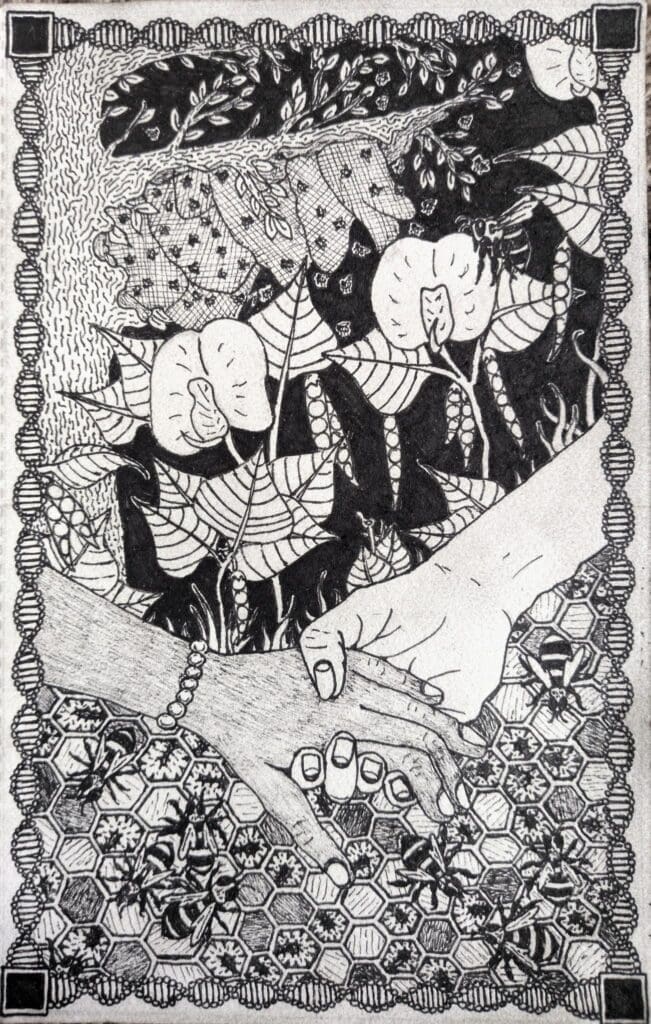
Just like beans need bees to pollinate them, the bees need the pollen from bean flowers to feed their bee families. And there is abundance of pollen for both the plants and the bees to thrive—cooperation creates more abundance.
Our bodies maintain integrity through self-renewal. Cells in the human body replicate and grow, and maintain the same DNA in every cell. These are like the uncompromising values of the AKC.
Principle in Action:
- We make time to intentionally welcome each person who joins an AKC
- We share our group’s uncompromising principles
- We adapt recipes—if certain ingredients are missing, we replace them with what we have
- We work together
Autonomous Kitchen Councils operate with the following expectations for members:
- Enter with humility
- Engage in the processes of the organizing space
- Ask before taking
- Treat all beings and spaces with care
- Share responsibility for the work that needs to be done to keep everyone safe and cared for
II. Rotation
We have awareness of who takes up certain roles and tasks in the AKC and intentionally rotate them among comrades in the space, in order to prevent oppressive patterns from happening in our spaces. Routinely rotating tasks and responsibilities prevents burnout, as well as anyone getting “expertise,” which can lead to power imbalances and weaponized incompetence, and can hinder ongoing collectivist processes in our spaces.
Another important consideration is to get a diversity of people taking up different roles, in order for us to create more inclusive spaces. For example, by giving roles to disabled members, we can learn what their needs are and make adjustments to the kitchen space so it is accessible for them.
We all take responsibility to co-create the AKC. That is to say, we all are responsible for caring for and protecting the spaces we created and inhabit.
Principle in Our Living World:
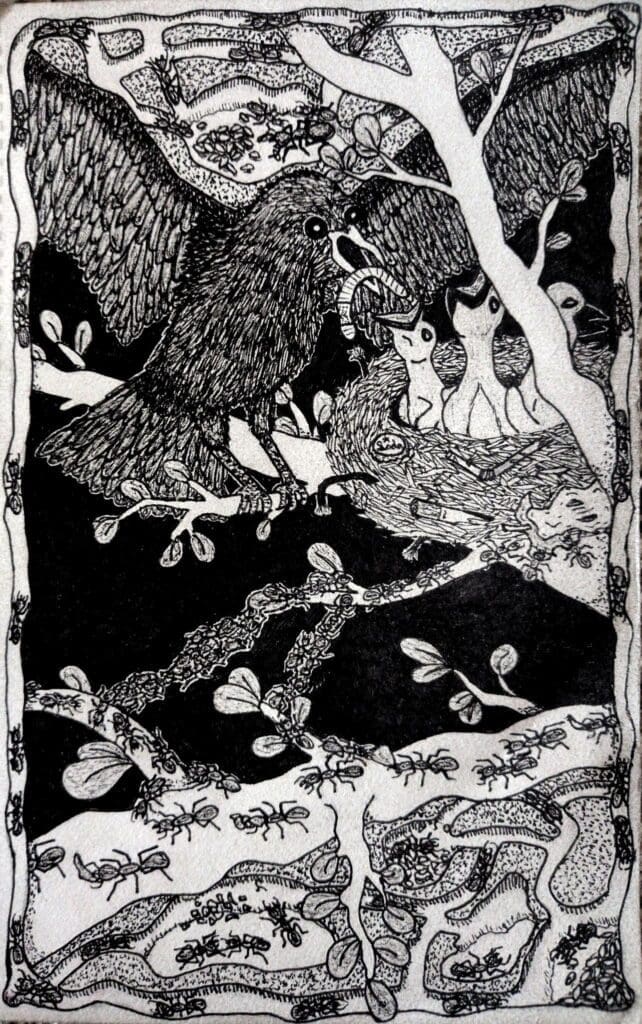
Ants are very organized and take turns teaching and learning skills—like foraging for food, feeding and nursing babies, and cleaning the ant nest.
Crows exist collectively within intricate social structures; teaching each other skills and behaviors whilst exercising their resourcefulness and adaptability across many enviornments.
Principle in Action:
- When someone doesn’t know how to do something, teach them. Then, later, they teach this skill to someone else in the group.
- Keep checking in with each other
- Ask to change tasks when you feel it’s been enough or see when you see someone else always doing the same task (yes we see you, dish fairies!)
III. Local Solidarity
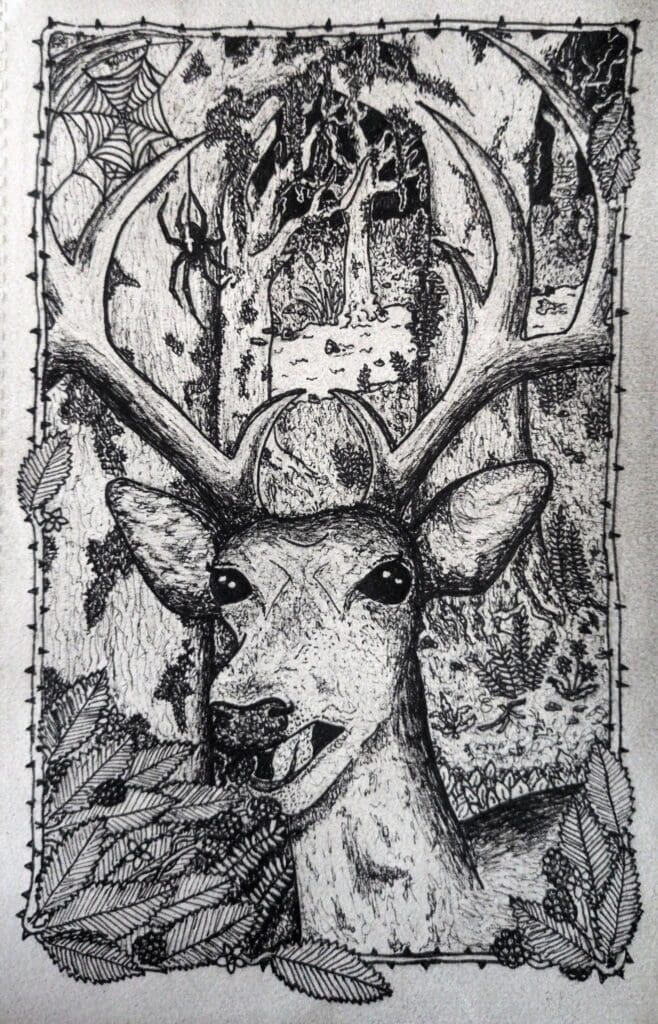
The AKC is attuned and responsive to its context. That means we are aware of and respond to the specific struggles our people face in our community. The AKC embeds within the community by following local liberatory customs and traditions, and respecting the land, heritage, and history of this place. This principle is also about mutual aid. Council members actively nourish roots and relationships in local organizing.
Principle in Our Living World:
There are many species in our world and they are uniquely adapted to their bioregion. They co-evolved with other species—bees and flowering plants, trees and mycorrhizal fungi, lichens as a symbiosis of fungi and algae, and many more.
This was possible because they were attuned and responsive to their local communities, through rapid feedback loops, making use of readily available materials, energy, knowledge, and cultivating cooperative relationships.
Principle in Action:
- Start building an AKC with people close to you in your daily life
- Expand this AKC circle with other people who need help and care in your community. Do you care for your friends? Listen to them? Cook with them? You are already an AKC, now you just need to make it explicit!
IV. Sovereign Food Cultures
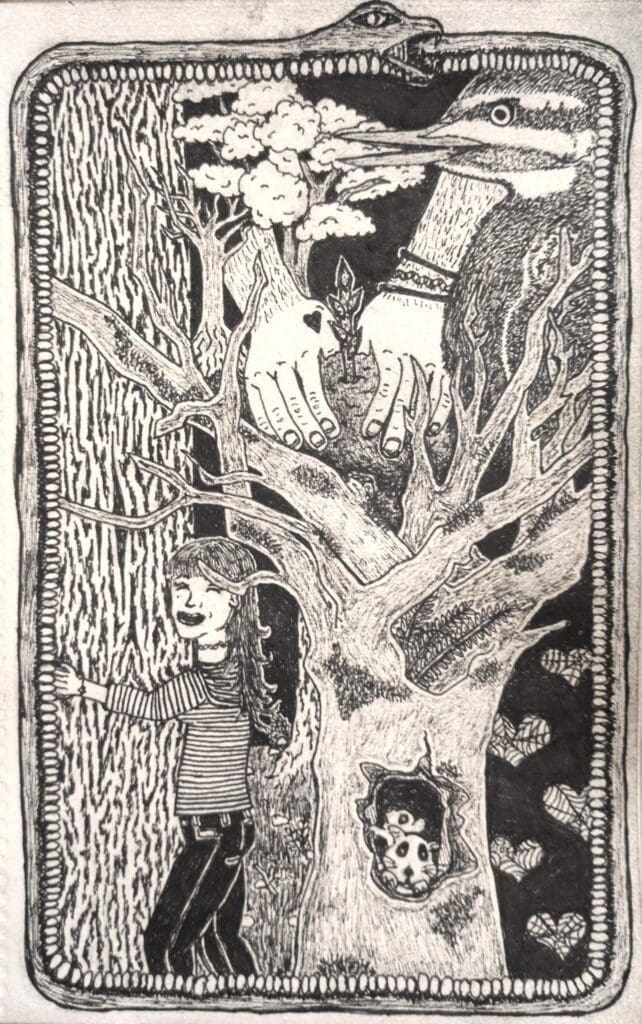
AKCs create traditions that elevate and politicize the status of nourishment and collective care, while decolonizing our relationships with food, cooking, and resources.
The AKC supports members’ shift from individualism to collectivism. It incorporates ceremonies and traditions of gratitude for workers and land; seasonal rituals that acknowledge transitions and change; and wellness rituals and practices that support restoring what we have taken from each other and the land.
Principle in Our Living World:
Life cooperates and creates more abundance that allows more life to thrive. This is a sacred embodiment of interbeing—we are completely entagled with every other thing. You can only exist because of other life forms before us and with us. And in our human world, everything is political.
Principle in Action:
- Share everything
- Practice rituals and ceremonies together for specific intentions
- Acknowledge and express gratitude for the land, the people, and all the beings that have made you and your AKC possible
- Care for each other, nourish each other, protect each other
- Share your stories of collective cooking to inspire and teach others how to adopt these practices
How to Start an AKC
- A kitchen council is organized by people who know each other (neighbors, coworkers, people organizing together) and who build care and safety for each other, and for people who share the gift of abundance and understand resources as a collective means for safety and care, not for the power or accumulation of any individual. Abundance is for all.
- A kitchen council cannot be less than three people, but the kernel of a kitchen council organization surely starts with a conversation between two people.
- Three people amount to a grouping that can make collective statements and push for initiatives.
- Once those three or more people have found each other, the kitchen council can formulate their agreements, values, and how they want to work: how many times a month will they meet? How many people will be welcome to join the council? Every single kitchen council must know, understand, and agree with the four main principles of the AKC and its philosophy of abundance.
- Once basic agreements and logistics are in place, meetings should start to be scheduled. As the council grows and once the ideal number is reached, the council will revisit their logistical agreements and values together with all members. When one kitchen council has been founded, it can connect to other groupings of people to ensure its principles can be made manifest in the broader world.
- Start small—who do you share food with daily?
- Grow incrementally: how can we share abundance?

Recipes
The collective making of food changes the nature of conviviality from a reproduction of the social forced upon a gendered sub-class into a moment of social interrelation between worker realities.
Ethnic traditions, religious shibboleths, allergies—all come out in the food-making process.
When we cook together we have to deal with the reality of each other’s bodies in space and in time together.
Mastering food collaboration prefigures other kinds of collaborations across disparate body-mind spaces and times.
Through the process of making food, we provide nourishment to our families and loved ones!
Use what ingredients are available to you. We are all coming from different contexts.
We want to incite processes of collectivity. We are defending abundance everywhere. Come together to make food.
We need to fight time scarcity!
We allow flexibility!

Smoked potatoes in a manka
Gabriela, with the Aquike Zegarra and Riquelme Mamani families
This recipe emerged in my kitchen in Basel as an experiment in recreating the delicious aroma of tubers cooked in a pachamanca, which translates as “pot” or “food beneath the Earth,” from the Quechua runasimi in Cuzco (territory of the central Andes in Peru).
This hot-stone dish is part of my taste memory, which—despite being born and raised in Lima—inherits the interculturality of flavors and knowledges of my family, composed of migrants from both the coastal and Andean regions of Peru.
Pachamanca encompasses the pluralities of a collective meal for fiestas patronales, or special occasions, in Tayabamba (3,245 meters above sea level, Pataz, La Libertad), a typical Sunday family dish in Cieneguilla (300 meters above sea level, Lima province), and also a communal meal and ritual of gratitude after the harvests at the beginning of the dry season of the agricultural calendar in Huilloc (3,800 meters above sea level, Ollantaytambo, Cuzco).
Similarly, the process of cooking pachamanca varies according to the territory and the community it will nourish: from a pit carved into the ground, supported by layers of river stones and covered with aromatic herbs and sheep wool shawls; to a large clay, ceramic, or metal pot cooked over low heat, where the ingredients are marinated and cooked between layers of banana leaves or corn husks.
However, the constant is that it always includes a generous base of tubers, especially native potatoes, or oca (oxalis tuberosa), and for flavoring/seasoning we use huacatay (tagetes minuta) or chincho (tagetes elliptica), a variety of medicinal and aromatic high Andean plant the grows wild or is cultivated alongside potatoes for its pest-repellent properties.
What is cultivated and grows together tastes good together, and even more so when shared in gratitude with others—and this is the wisdom and resistance of pachamanca. For our migrant kitchens, the recipe I propose could become an act of rooting yourself in your environment, its communities, labor, and joys connected to the cycles of the Earth.
So, I recommend starting the recipe with a trip to the market and/or a visit to the farm in search of fresh root vegetables and aromatic herbs (freshly harvested, if possible), whatever the territory/community and season where you are has to offer. This is a great opportunity to talk to others who may have access to their own land or crops, for they will know what is in season, as well as the uses and cooking times of the tubers.
If you have a tuber with thin skin (just scratch the skin with your fingernail to find out), it will be important to have some kind of fat, of any origin, to add enough so it does not stick to to the surface of the container where you choose to cook it.
The process is simple: wash, season, and coat the tubers with a little of this fat, and depending on your “pot,” arrange them between layers of herbs. The time and cooking will depend on the type of tuber and your energy source, but the basic idea is that it is uniform and by convection—like a long, careful, and sustained hug.
Serve them warm, fresh out of your manka, accompanied by a sauce or uchucuta (hot sauce, and another story/recipe!), and share them with those you have or intend to have a reciprocal bond with.
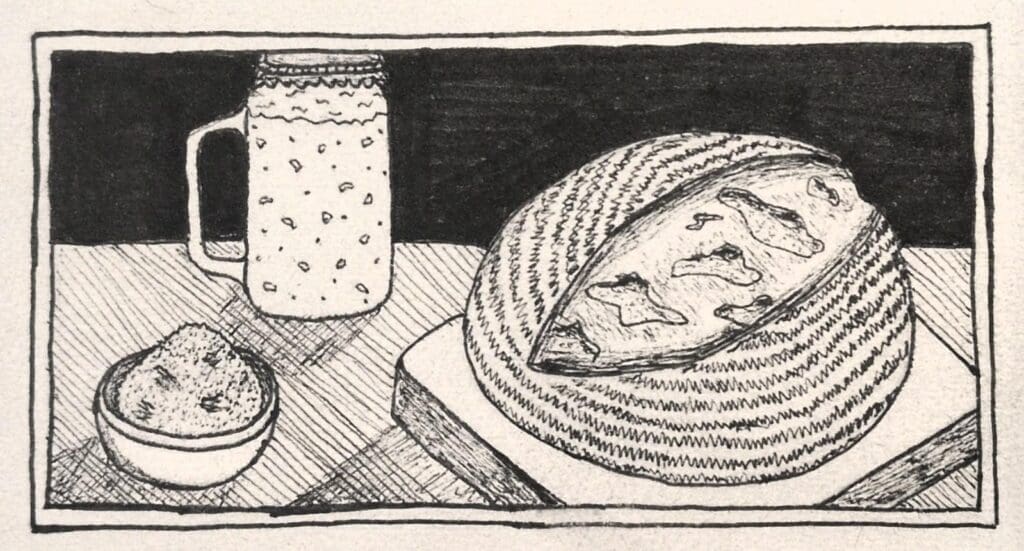
Sourdough starter & bread
You will need:
- A jar (optional: a rubber band around it to track the elevation)
- A bag of whole wheat flour
- Water
- Ten minutes a day, for (probably more than) seven days
Day 1: Combine 60g of whole wheat flour with 60g of water in the jar, until you have a smooth paste. Cover it with a lid and place in a warm spot to get the fermentation process started. Let it rest for a day.
Each day from from day 3 on: Remove half of the paste in the jar, add fresh paste (combined 60g flour and 60g water), and return it to its resting spot. This process is called “feeding.” Signs of rising are typically bubbles in your jar, but do not be alarmed if there are no bubbles in the first few days.
Each day this will get progressively more starter in the jar. On the third day you remove 60g and add 120g, making a paste of 180g. On the fourth day you remove 90g and add 120g, making a paste of 210g, and so on. You can stop feeding your sourdough starter daily once it has doubled in size and there are plenty of bubbles in your jar.
An established sourdough starter will need feeding approximately two to three times a week if it is stored at room temperature, and about once a week if it is stored in a cooler place (a fridge). Remember to feed it if you remove a bit to bake. Alternatively, you can separate portions in an ice cube tray or a freezer-safe bag, and store your sourdough starter in the freezer for longer storage of up to a year. Keep in mind that your sourdough will need to be fed for a few days after freezing, before you use it again.
Please discard your sourdough starter if there are signs of mold or discoloration! If this happens it is not safe for consumption!
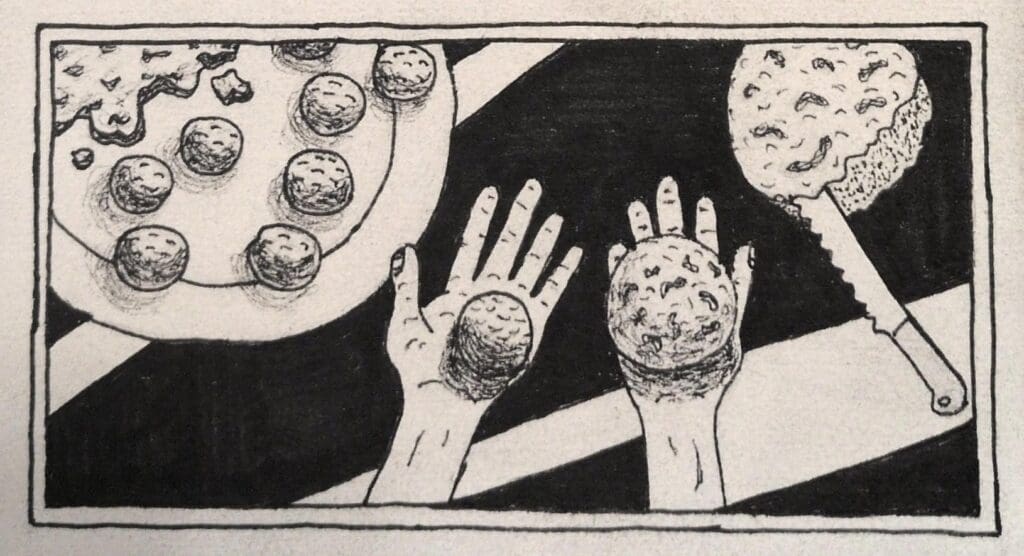
Gorditas
Corn, the grain of resistance, is deeply rooted in the cultures of Indigenous peoples across the Americas, shaping traditions, practices, and delicious food. Corn is now grown all around the world and used in different cuisines in many different shapes and forms.
One of the traditional ways of preparing corn for eating involves drying the kernels, soaking them in limewater, and grinding them to a paste—making masa. While the traditional process of making masa is a wonderful opportunity for coming together and building community, masa harina, or dried masa, is also commercially available and perfect for making delicious food.
Here is a recipe to make tortillas and gorditas using masa harina, water, and tools you can find in your house!
Ingredients for five gorditas/tortillas:
- 1 cup masa harina
- 1/3 cup water
You will need:
- A plastic bag cut in the shape of the picture (two connected circles), to make a separator
- Tortilla press or a plate with a flat bottom
- Slightly wet hands
- A nonstick pan—or you can use cooking oil
- A bowl and towel to put the warm tortillas/gorditas in (make sure the towel is washed without fabric softener)
Tortillas are perfect to eat fresh out of the pan, and gorditas are very convenient to pack for food on the go, as they can be stuffed. The differeces between the two is the thickness of the dough.
Mix the masa and water in a bowl and roll out five small balls between your palsm. Each should fit in the palm of your hand. The consistency of the dough should be dry enough that th eball keeps the shape, but not so dry that it crumbles when you try to roll them out. Having wet hands helps with this process. Do not be afraid to adjust the water as needed in this recipe, as each kitchen might have different humidity levels depending on your bioregion.
For a tortilla: Grab a ball of dough, place it between your plastic layers, and press it slowly in your (makeshift) press until it is a very thin disk, maybe 2mm, but not to the point it breaks. Open one side of your plastic bag and check which side of your tortilla is thicker, and transfer that side to your hand. If your tortilla breaks at any point, you can roll it out and start again!
In the meantime, heat up the nonstick pan, or make a pan nonstick using a small amount of cooking oil of your choice. Place the tortilla on the hot pan and let it cook for about one minute on each side. Usually the sides of the tortilla will curl up a tiny bit, or it will make a few bubbles in the center and unstick from the pan. You can flip it when you see that! Remove it from the pan and place in a bowl with a towel to keep it from getting soggy while the rest of the tortillas cook.
For a gordita: Grab a ball of dough, place it between your plastic layers, and press it slowly in your press to about twice the thickness of a tortilla. Transfer the gordita to the pan in the same way as a tortilla, but let it cook for two minutes each side because it is a bit thicker.
Additional points: slapping your gordita can help the inside separate easier! Once it is cooked, remove it from the pan and hold it (with a towel on your hand) so you can make an opening. Grab a butter knife and go from the side of the gordita—ideally the opening is big enough that you can twist the knife around to separate the two layers and make a pocket, but not so big that the gordita falls open.
Once you have your pocket, you can fill it and reseal it by pinching the opening closed. Wrap the gordita for extra security, and take it with you to each for lunch or a snack.
Serve with leftovers!
Print this Zine
Connect with the AKC Web: akccollective@riseup.net
Gratitude
Tlazocamati/Gracias/Thanks/Merci/Danke to all supporting AKC work everywhere! From folks editing, designing, translating, and writing for this zine to people supporting AKC webbing efforts by hosting events, cooking, fundraising, donating time, skills, and resources. This is truly a collective effort.
Credits
Ned Flowers, Kat, Yummy, Aliki, nino, corn, Orki, sage, Maya, malva, Tease, San, Friends at La Pépinière d’Aubervilliers, girl, Naníchí Símaran, Yarrow K, Sam from a forest in Germany, Madison Mugwort, AKC semillas TN, AMMRA, Abundia, Chuta, thunderhols, andrea, Nathalie, Gorgo, Gabrielaaz.

Consiglio Autonomo di Cucina: Tessere reti di abbondanza