The Repercussions of the Regional War on Iraq
by Jamal Al-Sayigh of The Peoples Want network
3 March 2026
With the escalation of confrontation between Israel, the United States, and Iran, Iraq has entered an extremely tense phase at all security, political, and economic levels. Due to its geopolitical position and the entanglement of its internal forces with regional axes, Iraq has always been within the direct sphere of influence of any military escalation in the region—especially given that the Iraqi system has been under both Iranian and American dominance.
Over the past two electoral cycles, Iranian influence has expanded further through the victory of the Coordination Framework, composed of political forces and militias affiliated with Iran. With the withdrawal of the Sadrist movement and the loss of the civil forces, the Coordination Framework now almost exclusively controls power in Iraq.
From the first hours of the strike on Iran, sites affiliated with factions of the Popular Mobilization Forces (PMF) were attacked in Jurf al-Sakhar, Diyala, Basra, and Taji. Armed factions loyal to Iran responded by targeting American sites inside Iraq and in the Kurdistan Region with rockets and drones. The US consulate in Erbil and Camp Victory at Baghdad Airport were struck, leading to the complete closure of the airport. This has effectively placed the country within a sphere of indirect confrontation and raised security concerns to dangerous levels.
Domestically, supporters of factions and militias gathered at the entrances of the Green Zone, blocking several main roads and bridges. Demonstrations moved toward the Green Zone and the US embassy. In some areas, the situation escalated into armed confrontations after gunfire targeted security forces. Exchanges of fire are ongoing, resulting in several injuries and raising serious fears of a slide toward internal conflict that could threaten civil peace and potentially lead to civil war. For the militias, this is seen as an existential battle.
Politically, fears are growing within the Coordination Framework, particularly in light of rapid developments in Iran, especially following the assassination of Supreme Leader Ali Khamenei. Any potential collapse in the structure of the Iranian regime would redraw the balance of power inside Iraq and threaten the future of forces strategically aligned with Tehran. This makes factions more brutal and more prepared to escalate, and such a transformation would not occur without bloody conflict.
In this context, accusations of treason are intensifying against opponents and activists. Anyone critical of Iranian policies or forces loyal to them is accused of working for the United States or Israel.
On March 2, we lost our comrade, the communist feminist activist Yanar Mohammed, who was assassinated in a cowardly attack carried out by militias at the door of her home in Baghdad due to her civic activism, particularly her role in Alliance 188 opposing amendments to the Personal Status Law. The incident was accompanied by escalating hate speech on social media, with some voices justifying the crime on ideological and religious grounds—a worrying indicator of declining tolerance and erosion of public space.
Economically, Iraq is passing through a sensitive phase due to the closure of borders and airspace, which has disrupted the flow of food and construction materials, leading to rising prices of essential goods, including food and medicine. The dollar exchange rate has also risen amid anxiety and uncertainty. Pressure is increasing with the closure of the Strait of Hormuz, Iraq’s main maritime outlet for oil exports, threatening public revenues and placing government finances under unprecedented strain.
Additionally, the Iraqi government faces increasing American pressure to restructure the executive authority and form a new government away from Iranian dominance, with a deadline of no more than one week. This deepens the political impasse and places the regime before difficult choices within complex internal balances. Trump is attempting to reduce Iraq’s options: either form a government completely outside Iranian influence or face sanctions and be counted as part of Iran in the current war.
In conclusion, Iraq stands today at a decisive crossroads: between the danger of becoming an open battlefield, the risk of internal unrest and civil war, and a worsening economic crisis that could directly undermine social stability and people’s livelihoods.
Internationalist solidarity is urgently needed—not in the form of geopolitical alignment, but in defense of:
- Iraqi civil society and independent activists
- Feminist and secular movements under threat
- Trade unions and grassroots organizers
- The right to political dissent without fear of assassination
While Iraq must not be reduced to a proxy battleground, our defense is not reduced to the national boundaries. Any response to the current situation can only be thought of transnationally.
The fight for democratic space, social justice, and popular sovereignty in Iraq is part of a broader international struggle against sectarian authoritarianism and (petty and grande) imperial power politics.
Now is the moment to stand together with those inside the geographies of Iran, Iraq, Syria, Lebanon and Sudan, who resist war, resist militia domination, and resist the suffocation of public life.
Text printed with the author’s permission.
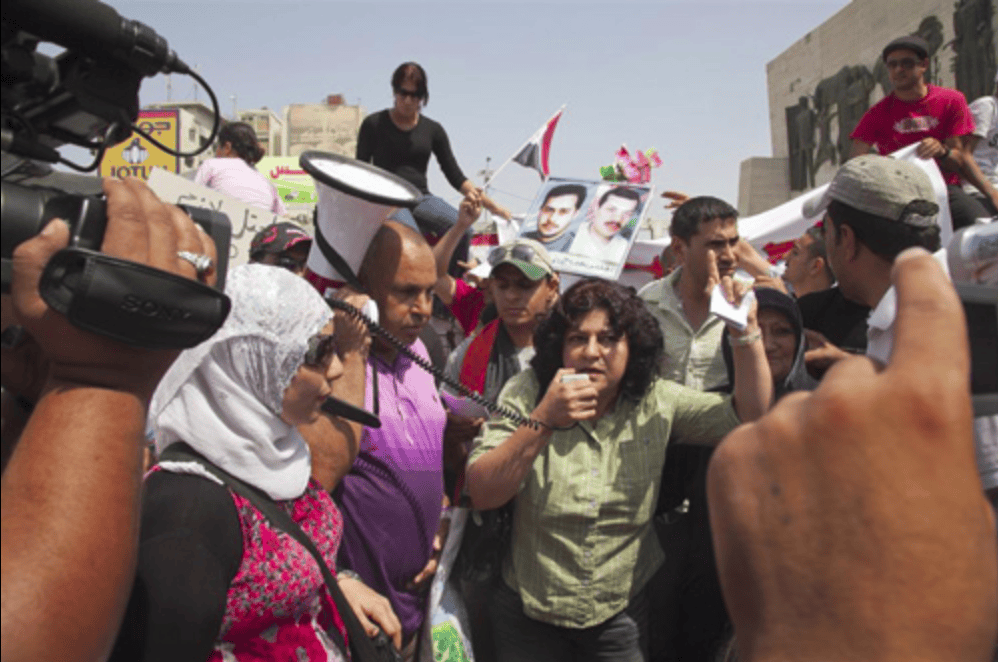
Featured image: 2013 photo of Yanar Mohammed in her element. Source: A Celebration of Women