Transcribed from the 7 September 2026 episode of the It Could Happen Here podcast and reproduced in a spirit of well-meaning autonomy, with the kind permission of the episode host.
There will always be the objective conditions for another revolt. What’s missing is the subjective conditions, which means: Hossam and Dana and Mohamed and Michael—are we organized? Are we trying to put out new ideas? Are we trying to mobilize, even under repression?
Dana El Kurd: Hello everyone, and welcome to It Could Happen Here. My name is Dana El Kurd, I’m a researcher of Arab and Palestinian politics, and today I’m joined by Hossam El-Hamalawy.
Hossam is a journalist and socialist from Cairo who was among the organizers of the 2011 protests. He’s been involved in the labor movement and the fight against police brutality in Egypt for many years, and holds a PhD in political science from the Free University of Berlin. He publishes a weekly newsletter on Egyptian politics, and is author of the new book Counterrevolution in Egypt: Sisi’s New Republic.
Hossam, thanks for joining us.
Hossam El-Hamalawy: Thank you, Dana, for having me.
DK: At the beginning of your book, you talk about your own abduction and torture by state security in 2000, and you were an organizer of the 2011 uprisings. How did living through this repression on a personal level shape the way that you studied the repression? And what can a participant see that an outside scholar might miss?
HH: There was a long-running tradition in academia and in journalism, which fortunately is being challenged over the past couple decades (at least), of tending to regard the scholar or the journalist as someone who is completely separate from whatever they are studying or reporting on. They should be “neutral,” “objective.” Any form of attachment, or passion for any cause, would be considered a conflict of interest, more or less.
But a great chunk of my career—and this is expressed in this book—I’ve been trying to challenge that. I consider myself a scholar-activist, not just a scholar. I was also an activist-journalist, not just a journalist. In that regard, in answer to your question, my experience when it comes to state repression has definitely shaped not just my intellectual trajectory but my own personal life. After all, I’m doing this interview with you from Berlin, not from my home in Cairo, which I had to leave in 2015 and can’t go back, as long as this regime exists.
My repression, which included repeated arrests, torture, continuous threats to me and my family, exclusion from jobs—the list is too long—planted in me a curiosity and also an existential reason to study who is repressing me. We tend to talk about “the state” or “the security apparatus,” and I was very much interested in putting faces and names to these kinds of entities.
Who is doing what when it comes to repression? Who is doing the monitoring, and who is doing the arrests? What is the profile of the officers who conduct these missions? Where do they come from, what’s their background, what is their life trajectories? How do they justify for themselves their actions? What is their worldview?
In so many ways, this curiosity has put me on a very long journey to study this apparatus—also with the declared aim of dismantling it one day, when we are victorious in the coming revolution.
DK: So you opened up the black box of the security apparatus and disentangled the things outside scholars gloss over, or lump different things together. Everything you’re saying resonates with me as a Palestinian studying Palestine: this endless suspicion of your own perspective. I’m glad, as you said, there has been a pushback from our region and from scholars and activists in other places.
But on the question of actually doing the research, it must have been challenging, because this regime wants to obfuscate, to hide its doers. It must have been challenging to find sources—how did you find that information? What was your methodology for the book?
HH: That’s a very good question. From the outside, Egypt looks like a very opaque country—for very reasonable causes. At the end of the day, this is a repressive regime; it’s allergic to the flow of information, and freedom of expression in general. Egypt is not a researcher-friendly country at all. Once you mention Egypt in academia, people are always reminded of Giulio Regeni, the Italian PhD scholar who was brutally tortured and murdered in Egypt.
We don’t have a Freedom of Information Act in Egypt that allows us access into the archives of the security apparatus, the military, and other institutions that belong to that sector. But you can always find your way if you decide to become innovative. I will just cite a couple of examples.
First, sometimes the best information you can get about an opaque military like the Egyptians’ is through their sponsors. The Egyptian military is sponsored by the US. In the US, even when it’s becoming Sisi-fied in so many aspects, still there is room: the Freedom of Information Act and other laws that allow you access.
When you are done with this recording, go to the US State Department website, check the FOIA section, and go back to 2011 and check Hillary Clinton’s emails that have been declassified. The intelligence reports in these emails almost contain the SCAF generals’ meeting minutes, where Hillary is saying, General [Hassan] al-Roueini said this, while the other general replied saying ‘No,’ as if she’s sitting in on the meeting. They are her proxies and clients, so she must get the information right away.
So I managed to get tons of information through declassified US documents.
The second method I also invested some time in—just by the fact that the military are now in the front seat, not in the back seat, when it comes to ruling (we’ll touch more on this later), there are tons of mics that are shoved in front of the mouths of the different generals, and the different senior officials, as well as Sisi—and these guys don’t have any filters. They haven’t received the same sophisticated training militaries in Western “democracies” have, where they are always in contact with the media.
The kind of garbage, and so many secretive things you actually can’t believe that they are saying—it’s unbelievable! Just by browsing through their public statements, they are spilling the beans left and right.
The last thing I’ll say about sources: I once heard a story, in the beginning of the 2000s or late 1990s, when I was still a student—and to be honest, I have no idea if this story happened or if it’s an urban myth. But when I heard it, it resonated with me and stayed with me for years to come, and inspired me. The story goes as follows:
Following the peace treaty with Israel, when the Egyptians and Israelis were sitting discussing joint cooperation projects, the Israelis would propose some agricultural project, for example, and then tell the Egyptians, “…and we think that Mr. Mohamed XYZ at this department at your agricultural ministry would be the most qualified to lead it.” And then they would suggest others, and they would keep proposing names. The Egyptians were shocked to find out, as the story goes, that the Mossad had a map of the entire Egyptian bureaucracy just by monitoring the obituaries.
Maybe Westerners don’t know this, but for obituaries in the Arab world, you tend to put your entire family tree and brag about all the members of the family—
DK: This engineer, this doctor…
HH: Yeah, and for each one you start posting their CVs, their achievements!
When I heard this story, it stuck with me. I applied that same methodology in trying to track down police officers who were involved in torture in the years running up to the 2011 revolution. I used the same technique in my research. I managed to map, for example, the new administrative structure of the military intelligence by surfing through obituaries, and digging up names and departments and things like that.
There is always a way to maneuver.
DK: I like how the security apparatus and the military become a family business. And I love the fact that we can use the structures of American empire to study its outposts. That’s very clever on your part, to weaponize those sources.
Let’s get into the argument of the book. Basically, there’s this idea of a counterrevolution—generally speaking, the way people think about counterrevolutions is the restoration of an old regime. But your main argument is that Sisi didn’t restore Mubarak’s Egypt, but built something fundamentally different. You call it the “Second Republic.”
What makes this order different? And why does that distinction matter for how the world should understand Egypt right now?
HH: My book was sort of an intervention in political debates that have been happening among the Egyptian dissident community. When I started this research—I’m talking here about the end of 2017. My book is my doctoral dissertation, which I did here in Berlin. At that time, there were still debates about whether this regime is a return to the Mubarak order or if it’s something new.
Speaking to you in 2026, any five-year-old in Egypt would know that this is something completely different. You don’t need to do a PhD about it. But at the time, there was still so much unclarity. And my argument was: a victorious counterrevolution does not restore the old order, simply because the old order has failed. And by “failure” here, I don’t mean the kind of failure that you and I would think of: The old regime was not democratic enough, the old regime did not distribute wealth in an equal fashion. No, in the eyes of the counterrevolutionaries, the old regime failed because it failed to repress the revolution.
So the kind of victorious regimes that come out of such a counterrevolution are usually regimes that try to avoid the mistakes of the past. The generals, for example, who led the 2013 military coup regarded Mubarak as too lenient, too weak. They completely detested the way that Hosni Mubarak “allowed” human rights NGOs to operate in the country. They couldn’t believe Hosni Mubarak “allowed” people to denounce him in the press.
This was not a restoration of the old Mubarak authoritarian formula. Make no mistake, I’m not nostalgic for the Mubarak days, I don’t see it as a viable model. But this was not a restoration of that old authoritarian formula, instead Sisi built a new regime—by the way, he’s the one who coined the phrase “New Republic” or “Second Republic.” I know people like to ridicule this term, for very obvious reasons, but it’s actually quite accurate.
He contrasts it to the First Republic, which lasted from 1953—one year after the Free Officers Coup, when they abolished the monarchy and declared the republic—until 2013. This is all of it: It included three successive regimes: Nasser, Sadat, and Mubarak. Sisi lumped them all together in one blob as the First Republic—and I’m arguing that he’s right. Even if on the surface they had different inclinations, different stated goals, different international alliances, when it comes to the core of how the state machine was organized, they didn’t differ that much. And there was some logic in organizing the security apparatus which completely changed after 2013.
DK: Let’s get into that. [Gamal] Abdel Nasser and onward—they pitted different parts of the security apparatus against each other. Correct me if I’m wrong, but my understanding is that under Mubarak’s regime, they bolstered General Intelligence, always historically fragmenting different parts of the security apparatus so they are rivals. And of course the dictator can be the arbiter.
But in the book you’re saying Sisi unifies them for the first time. Why is that unification the key to understanding not only the type of repression but the scale? And could it have happened without the 2011 revolution?
HH: There is a vast amount of literature in political science that discusses this term: the dominant perceived threat. The argument that usually revolves around this term is that when autocrats reach power, they usually have a dominant perceived threat. Don’t get me wrong: any good autocrat, if they want to stay in power for a long time, has to shield themselves from all sorts of dangers. But there is always a dominant one. According to that dominant one, they start structuring their security apparatus.
The argument also goes (and I support it, I think it’s correct and accurate) that if your dominant perceived threat is that of a military coup, then you tend to fragment your apparatus, as you just clarified. You create multiple security institutions (and I mean “security” in the functional sense—the military here would be a security institution); they will all have overlapping mandates, and hardly any communication or information-sharing between them; they are always in a state of competition for resources; and there isn’t much horizontal communication.
The only channels of communication are vertical, so that only the ruler would have the bird’s eye view of what’s happening beneath him. At the same time, this ruler or autocrat will definitely take precautions against riots, against foreign invasions, or what have you. But if the dominant perceived threat is that of a military coup, they will do as we just explained.
So how did the First Republic start? In July 1952, an eclectic group of nationalist army officers, led by colonel Gamal Abdel Nasser, overthrew the British-backed king and declared the republic a year later. This was a time when coups were almost a fashionable thing to do across the Global South. These were the years of decolonization; at the time, the militaries were still regarded in a favorable light by the nations that were still being formed—many of them came from the anticolonial fights. The military was regarded as a modernizing professional force that can get the country to go forward and catch up with the West, and break dependency ties.
There were all of these kinds of nostalgic, romanticized visions of the military, so Egypt was not really that unique. It was happening across our region, and it was happening across the Global South. So the immediate concern of these conspirators was a counter-coup—makes sense. This was the dominant perceived threat. That’s when the military intelligence colonel, Zakaria Mohieddin, who was dubbed “Nasser’s Beria” (in reference to Stalin’s [Lavrentiy] Beria), organized this security setup, which continued with us all the way up until 2013.
He fragmented the security sector. There was the military, there was the interior ministry and its secret police (which changed its name several times, from Al-Mabahith Al Aammah to Mabahith Amn El Dawla, to Amn El Watani after the revolution), and he created the General Intelligence Service in 1954, or our mukhabarat, as we call it.
By the way, it was modeled along the structure of the CIA from the start. They were very impressed with the CIA, and actually they enjoyed good relations in order to fight communism. Many people don’t know that initially the Free Officers didn’t really express any left-leaning sympathies, but were pushed into it in the following years.
So this was the security setup. Not in their wildest dreams did they ever imagine that a revolution could happen in Egypt—I mean a proper, popular revolution. This is because our rulers, even when they came into the post-colonial years, still maintained this colonial look whereby they despised their people. They saw the Egyptians as human beings without agency; they regarded the Egyptians as incapable of self-organizing, and that if they [the rulers] are “let free” or “let loose” they will bring the whole country together—there always has to be some kind of patriarchal guardianship of the Egyptians.
They expected a few riots to happen here and there, maybe some strikes here and there, but not in their wildest nightmares did they think a revolution could happen—then comes 2011 and suddenly they are all shocked. For two and a half years, they were panicking about the fact that the entire regime could have collapsed. Out of this trauma and paranoia comes the counterrevolutionary regime of Abdel Fattah El-Sisi, where the dominant perceived threat now is that of a popular revolution.
This is not my own analysis; Sisi does not miss a single occasion to bring up 2011, and warns of 2011, and talks about the conspiracies to bring down the state. Even just a few days ago, he inaugurated the “Octagon.” If the Americans have the Pentagon, we have the Octagon—and the Octagon is not to protect the head of the state and the head of the army and the senior brass from foreign invasions, god forbid. Sisi said it: he said, We’re not going to repeat another 2011, which brought the whole country to a standstill. Now we’re moving the “brain” of the state somewhere safe.
What ensued was the unification of the security apparatus for the first time since 1952. Don’t get me wrong: they are still three separate institutions. Friction is bound to happen between them, and it does happen every now and then. They might have different views, but they are not in competition—they are coordinating, they are sharing information. Sometimes they even share the same structures. There are units within the Egyptian army now that officially have the police as part of it, like Unit 888 for example. They coordinate and do joint operations all throughout the Sinai counterinsurgency and in the “War on Terror” in the Nile valley.
In so many ways, everyone now understands that the military is the apex ruler on the top, but with it, its younger siblings—the mukhabarat and the interior ministry—are in this unholy alliance trying to protect the state from the conspiracies of the evil Egyptian people, at the end of the day.
DK: Because of the emergence from decolonization, and because of the wars with Israel—because of all the history that the Egyptian military has in the country—it’s common knowledge, and public opinion would back it up to some degree, that Egyptian public perception has been very pro-military, and every ruler has come from a military background.
Given that the Egyptian people have now been named the dominant threat, do you think that is changing public perception of the military apparatus?
HH: Let me first go back to before 2011. Whether Egyptians regarded the military favorably or not, there is definitely this factor, which exists in almost every country (you’re in America so you understand this too): the military is always a core pillar of whatever nationalist and patriotic ideology that exists in any country. In the case of Egypt, the military—especially its role in the 1973 war against Israel, which is always depicted in our school curriculums and movies and cultural production as a smashing victory against the Israelis (which is not completely accurate)—there is definitely this glorification.
But here’s the thing. Those who tell me that Egyptians love the military and they regard it favorably—I always tell them: when it’s conscription time, do you find everyone running to the conscription centers because they can’t wait for the moment they put on the uniform and get humiliated in some military factory or some desert camp? Or do people try to find whatever excuses, fabricate medical reasons, or buy their way out of the military? Honestly, from my humble knowledge, and from what I saw all throughout my life in Egypt, it’s a nightmare. Everyone tries to buy their way out of the military.
Now, when the military intervened in the revolution—I’ll go back a little bit: the military was not running traffic, the military was not doing the actual daily policing before 2011. So most of the hatred was directed against the police, because they are the ones you see on a daily basis, who interact with you on a daily basis.
The military—it is true they were in their camps, but their tentacles were all over society. They had their own social clubs. As an Egyptian man, until a certain age I can’t leave the country without their permission. They have their own economic and business ventures. They have their own special status. You don’t see the brass daily, but they are always there somehow, just remotely.
After 2011, they first deployed nationally in the streets following the collapse of the police. In my book, I do go into detail to clarify that not every welcomed their deployment, initially—with their own acknowledgment: I got statements from the military that talked about confrontations with the people as soon as they were deployed. But at the same time, there wasn’t any other choice in front of the people at the time, except trying to win over the conscripts and win over the military.
Confronting the military at the time, after a very bloody war of attrition with the police over the previous days, would have been suicide. The famous chant “El geysh wel sha’ab iyd wahda,” or “The people and the army are one hand” came out in that context, of us trying to win over the conscripts.
DK: An appeal.
HH: Exactly. I know this slogan later got co-opted by the military and by the counterrevolution to mean something else. But initially that’s what it meant.
So did the military keep its clout throughout the revolution? I belonged to the Egyptian Revolutionary Socialists, which is a revolutionary leftist organization in the country. We were the only ones to issue an anti-military statement on the first of February, during the eighteen days. No other political organization issued any anti-military statements. The first of February here was kind of prophetic—this was one day before the “Battle of the Camel,” which was enabled partially by the military at the time.
Initially we were an isolated minority; most of the public were against us. But then, as the revolution progressed, and people started to get disillusioned about the role of SCAF, the Supreme Council for the Armed Forces, they started to remember: It was the Egyptian RS who were warning us about this early on. And several confrontations exploded when it came to SCAF in the streets, whether it’s the Mohamed Mahmoud uprising in November, or the Occupy Cabinet clashes in December 2011.
So the thing of the military goes back and forth, up and down. I cannot say that it’s something constant. With 2013, there were sections of Egyptian society who supported the massacres and supported the army’s intervention. But there were also victims of that intervention. I think as Sisi lost clout as he proceeded—because he’s now governing the country solely by coercion, not consent, people can see in front of them how the military turned into a monster that’s taking over everything in the country.
Does that mean that when another revolution breaks out that everyone will be anti-military from the start? I don’t think so. If there isn’t a clear alternative that’s telling the people another solution is possible other than the military, they will play the same game of getting rid of the regime and retreating a few steps, but keeping things as they are.
DK: They are, unfortunately, in some ways in a strengthened position, as you said, because they learned the lesson of the possibility of popular mobilization. They’ve moved the capitol, there’s the Octagon, everything you’ve mentioned. It’s apt, the way you describe the regime acting like a colonial occupier more than as a national government, because it has this view of its own people as underdeveloped and unworthy of having their own political agency.
For Egyptians today in Egypt, what does daily life look like under this more aggressive system?
HH: Unfortunately it’s a very miserable situation. When Sisi rose to power and officially took office in 2014 as president, Egypt’s foreign debt was roughly $41 billion. Today it’s over $163 billion. In this year’s government budget, we’re talking about 63%, at least, going to debt services. Let me repeat that: sixty-three percent of the government budget is not going to go for education, it’s not going to go for health—it’s just going to pay the interest on the debt.
This means the following: there are austerity measures on steroids, to the extent that people are sharing their memories of the 2000s and 1990s as the “good old days.” Again, these were the days of the height of our neoliberal transition, which is part of why we had the revolution in the first place. But the economic situation now is that bad: even the austerity of the 1990s and 2000s sounds like heaven today.
Secondly, when it comes to political repression: compared to Sisi, Mubarak is a human rights activist. He’s a human rights defender compared to what we’re seeing today. The unification of the repressive apparatus in Egypt only led to heightened lethal and carceral violence. The regime—this might sound Orwellian—was boasting in public media that they are building the biggest prison on Earth. They are listing this as part of their achievements!
So how does life look today? There are three or four generations of Egyptians, from 2013 up until today, who graduated from university without ever taking part in a protest, without ever taking part in a political debate, without ever drafting a statement or distributing a leaflet, without ever taking part in a student union election, without every taking part in a parliamentary electoral campaign in their neighborhood. Sisi has desertified the political scene in Egypt.
He dismantled most of the political organizations in the country, even apolitical charities—any entity that’s independent from the state got taken over or dismantled by the state apparatus. So there is a really draconian regime that we’ve never witnessed in our modern history—even under Nasser. Nasser is usually the reference when it comes to military dictatorships, but it’s not true. He was a dictator of course, but he feared the military, he feared a coup, so he had to create a vast array of political institutions in order to counter the military’s power.
These political institutions were a vehicle for Egyptians (with limits, of course) to mobilize, to conduct, to discuss, to organize, and there was some space, some kind of political education—which is now nonexistent.
As I’m talking to you now, the Egyptian national football team has returned to Egypt, and they have had a great achievement at the World Cup, which never happened in our history. The government announced that they would prepare a mass popular welcome for the national team—in El-Alamein, not in Cairo. So they arrived at our border with Libya, all the way in the desert, to be received by state officials, and later they would meet Sisi; a few hundred people showed up in that scorching sun and heat in the desert to wait for them. Because this regime is so crowd-phobic, so people-phobic, they wouldn’t even dream of having this welcome in Cairo, where the real crowds are.
It is to that extent. Our football league, for example, which has always been famous and popular in the Arab world, let alone in Egypt, is being played without fans. It stayed this way for years, the stadiums were empty. They now allow only five thousand people to show up. The capacity of the Cairo stadium, for example, is one hundred and twenty thousand. I used to attend matches where it was full! Now they only allow five thousand fans for each one, because they are so crowd-phobic.
This is the reality we’re living under. But I’m also arguing, at the end of the book, that this is not a sustainable model.
DK: It’s an incarcerated population. But, as you said, at the end of the book you say there are cracks in the regime’s internal unity, and you also mention the parliamentary crisis. What do you think are the seeds of another 2011? What would resistance look like this time? What would it need to look like? You and I both agree that coercion alone cannot sustain these types of regimes.
HH: You were saying earlier they have learned their lessons—on the surface this might be true. But I would argue that they have probably learned the wrong lessons. There are counterrevolutions across history that were violent and repressive, and there was bloodshed, but these counterrevolutions, since they were far-sighted, tried to address some of the problems that led to the outbreak of the revolution in the first place. Not because they are democrats, but they want to defuse any potential problems.
Now let’s look at Egypt—and actually the Arab Spring in general, not just Egypt. There are tons of reasons why the Egyptian and the Arab revolutions broke out in 2011. But I can, in a reductionist way, simplify them into two main problems: one is the issue of political repression and police brutality; the other is the social question, or the unequal distribution of wealth. These were the two main structural problems that provided the objective conditions to have an uprising in Egypt—and the Arab world. I can generalize here, knowing that each country had its own specificities. Syria had its own conditions and problems; Tunisia had its own.
But these two [problems] were the common denominator, and the main motor force for these revolutions. In Egypt, the counterrevolution killed the revolution, yes. It repressed the revolutionaries. But did they provide answers to these two problems? No. Any child in Egypt could answer this, you don’t need a PhD scholar to tell you that political repression is much worse today. Secondly, when it comes to the distribution of wealth, the economic condition is unbelievable at this point.
As long as these two structural problems continue with us, there will always be the objective conditions for another revolt. What’s missing here is the subjective conditions, which means: Hossam and Dana and Mohamed and Michael—are we organized? Are we trying to put out new ideas? Are we trying to mobilize, even under repression, in campaigns here and there? That’s what’s missing. The repression was extremely effective in dismantling the different political organizations and independent unions in the country.
But part of why the repression was effective was the fact that there was full, blank-check backing from the regional and global allies of the regime—the UAE and Saudi Arabia specifically in the region, and globally there is both the US and the EU. I actually argue that the EU is much more complicit in enabling the Sisi regime than America—which goes against the historical trajectory of the regime.
The regime was confident they could ask its Gulf allies and the West, as long as it was fighting the revolution, as long as it was dismantling the Islamists, and as long as it’s killing this bogeyman called the January 2011 revolution—until Sisi woke up in 2021, with COVID and a war in Ukraine, to find out that our debt has spiraled out of control and that the Gulf were not really that keen on keeping these bailouts coming. There were even some leaked reports of Mohamed bin Zayed of the UAE complaining that Sisi thinks he’s an ATM.
I don’t know if that’s true or not, but it signaled a different mood. There was even a famous statement by Sisi, which then was taken down from most of the news websites at the time, but I screenshotted it, and I listened to the speech. He was complaining, saying something along the lines of: Some of our Arab brothers think Egypt is incapable of progress. He was lamenting the situation. That’s when the regime started to act in a very un-confident way. It released some political prisoners, called for a national dialogue.
That never really materialized into anything important, but it was a signal that they were scared. They were scared because the economic situation is bad, and because if any form of revolts take place, whether local or national, they don’t have a civil society, in the Gramscian sense, that can act as a buffer to protect them. Hosni Mubarak was an autocrat, it’s true, but Hosni Mubarak was presiding over a very vibrant civil society. It’s that civil society that actually saved the state from a full-fledged revolution in January 2011.
There was the Muslim Brotherhood to negotiate with: In exchange for suspending Tahrir, we will give you a share of the cake. There used to be leftwing political parties that you can try to negotiate with and promise some parliamentary seats in exchange for defusing industrial militancy. There was this, there was that. This is what enabled Hosni Mubarak to rule Egypt for three decades. But it is exactly that authoritarian formula that Sisi and the generals regarded as the main reason for 2011, so what we have now is the state presiding over society without any buffers.
It’s the military that’s micromanaging the society on a daily basis. It’s the police micromanaging society on a daily basis. The mukhabarat are doing the same, and there’s division of labor between them. They will remain united as long as things are going really well. But once you hit the wall, once a crisis erupts, whether you are a political organization or the state or a group of friends—that’s when people start looking at one another and exchange blame or propose diverse ideas. Some will think we should go left, others say we should go right, and that’s when cracks start to happen.
I’m not implying that divisions are now deep. But you can start seeing a few cracks here and there. And in the background, you also start to see an incremental rise in industrial actions over the past few years. It’s not like the 2006-2011 strike wave, which, once it erupted in Mahalla, spread by the domino effect all over the country. It’s very incremental. It has its own problems, but it’s rising.
It’s that social movement which I always bet on for the future.
DK: A lot to think about, and a lot of historical events come to mind. As you were talking I was thinking about the [1977] Bread Intifada [in Egypt]. But as you mention, there’s not a buffer to absorb it in today’s Egypt.
Another thing I’ve been thinking about the entire time is a sci-fi collection, Egypt + 100, about what Egypt looks like a hundred years after 2011. It imagines what moving the capitol and all these things will mean for Egyptians in a hundred years. It’s a little dystopian, but you’re leaving me more hopeful.
Thank you so much for coming on, I really appreciate your time.
HH: Thank you Dana, it’s always a pleasure to speak with you.
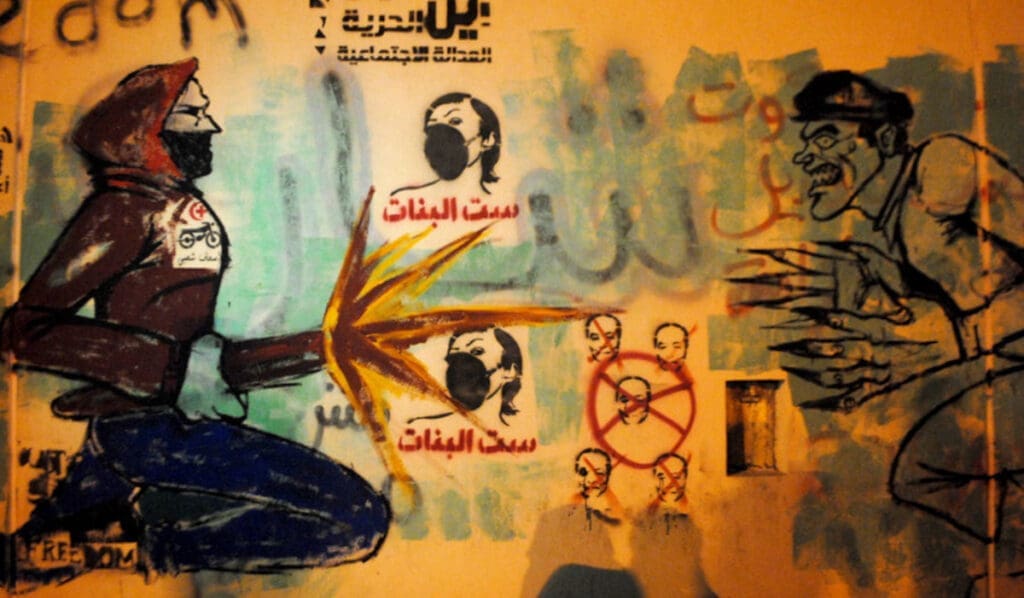
Featured image: Graffiti in Mohamed Mahmoud Street in Cairo, December 2011. Source: Lilian Wagdy via The Funambulist