AntiNote: We encountered this zine in an international space of exchange, and are republishing it with PDFs formatted for printing in the US in a spirit of grateful solidarity.
It is a trio of short essays that together comprise a powerful appeal to the Western left to confront the authoritarians and useful idiots among us who still impede the possibility of genuine internationalism from below by repeating fascist lies in the name of an utterly hollow “anti-imperialism.”
The zine author blogs on a large commercial platform under the name Radical Dumpling, and their writing also appears occasionally at the Left Renewal Blog. We encourage readers to support their valuable work of analytical witness, including by printing and sharing this zine.
I. A Letter to the Western Left
With frustration, from Central Eastern Europe
II. “No War but Class War” Is Often a Coward’s Slogan and the Leftist Version of “Thoughts and Prayers”
There’s nothing radical about flexing theory on people who are being bombed
III. The Western Left Can’t Stop Explaining the CEE Region to Itself
The delusion of “choice” between NATO or Russkiy Mir
by Radical Dumpling
9 August 2026 (print | read)
I.
A Letter to the Western Left
With frustration, from Central Eastern Europe
I’d say we need to talk about your silence, but really, we need to talk about your noise.
Specifically, all the noise you make about empire, liberation, and solidarity, while finding a thousand reasons to avert your gaze from Russian imperialism. You’ve written dissertations on the crimes of the United States and Israel (as you should), but when the missiles fall on Kharkiv or Kyiv, you start rambling like broken records about “NATO provocation” and “proxy wars.” You discover nuance only when the empire is draped in Soviet symbolism and aesthetics or is an entity you view as an adversary to American hegemony. It’s limiting and childish.
From here in this part of the world, it’s like watching a morality play performed in a language that doesn’t have a word for us. You treat imperialism as if it were an English-only phenomenon, simply a structure built in Washington, maintained by London, and nowhere else. But we have lived through Moscow’s “antifascist” tanks, through its “fraternal” occupations, through the kind of liberation that ends in prisons and deportations. Russian imperialism didn’t vanish with the tsars or the Soviets. It just learned to speak in your vocabulary and you’ve been dumb enough to hang on every word of it.
When we point this out, you call us “Russophobic,” as if memory and historical record were sins. You mock our revolutions (1968, 1989, Maidan) as “color revolutions,” CIA plots, or Western spectacles. You refuse to believe that people like us could rise up for our own sake. Liberation, in your eyes, is only authentic when it happens against a Western entity, or the mindless leftist influencers from PSL and meme-makers you follow speak about it.
Meanwhile, Ukrainian leftists, anarchists, feminists, and trade unionists are dying on the front lines. They fight not for NATO, but for the right to exist and the basic idea that the working class deserves to live out from under the shadow of Russian imperialism. Some of them were labor organizers, socialists, anarchists, punks, and antifascists. Now they are names etched into memorials, ignored by the very movement they thought would stand with them. Their deaths complicate your theories, so you look away or make the most pathetic of excuses.
And then there’s your slogan: “No war but class war.” Easy to chant from safety, impossible to live under bombardment. You say it like some magical spell, as if your smug rhetoric could stop artillery. But there is no pure class struggle when factories are shelled, when workers are deported, when trade unionists are executed. The class war you invoke is already happening. It’s taken the form of Ukrainian poor and working class people fighting to stay alive. You just refuse to recognize it, because the dead are speaking a language you don’t care to translate, or come from a country you always viewed as “problematic” because it challenged the Soviet-laden theory you desperately cling to and build your personalities around.
You say you hate empire, but you only ever mean one. You rage at US hegemony while excusing Russian conquest. You romanticize “multipolarity” as if choosing a different empire were the same as dismantling one. You tell yourselves that solidarity means opposing America at any cost, even if it means siding, in practice, with people who rape civilians, kidnap children for re-education, and bomb hospitals, and call it liberation.
And yet, we still try to meet you halfway or find some common ground. Many of us here stand with Palestine unequivocally. We are disgusted by Israeli apartheid, by the occupation and massacres, by the colonial arrogance that cloaks itself in security and nationalistic nonsense. We understand it because many of us have lived it. But when we enter your spaces, when we march beside you or try to organize, we feel the air change. You look at us with suspicion, as though Eastern Europeans couldn’t possibly grasp what colonization means. You mistake our geography for privilege, our grief for propaganda. You laugh in our faces and call us “brainwashed” when we try to tell our family stories or explain why Russian imperialism is still imperialism.
We see the fascism rising in your countries, and we care. We know what it looks like when the media lies, when vulnerable groups are targeted, when people disappear, when cruelty becomes national identity, and when truth collapses under dangerous ideology. We want you to win your battles against the state, against police, against fascists and billionaires. And we’re happy to do what we can to help. But solidarity cannot be one-way. You expect our empathy; you never learn our history, take our struggles seriously, or even view us as humans.
You call for revolution, but what you really want is ownership of the narrative. You quote Lenin or revolutionaries from the Global South, but ignore the people living through the kind of struggle you romanticize. You use slogans to ignore and distract from corpses. You flatten us into metaphors so your world remains comfortably simple: America the villain, everyone else a backdrop or inconsequential.
If your anti-imperialism only applies when the bombs fall in English, it’s not solidarity. It’s narcissism dressed up as virtue, and the very epitome of American exceptionalism.
We don’t need your pity. We need your clarity. We need you to see empire even when it wears the symbols you admire and cover yourselves in to try to appear edgy in your suburban American towns. Because if you can’t, if your so-called internationalist solidarity stops at Berlin, then you’re not building a global left. You’re just continuing to live inside your own delusional echo chambers.

II.
“No War but Class War” Is Often a Coward’s Slogan and the Leftist Version of “Thoughts and Prayers”
There’s nothing radical about flexing theory on people who are being bombed
The (honestly, not only) Western left has a talent for regurgitating revolutionary slogans without actually meaning anything or without the ability to read the room. Since 2022, many on the left have avoided facing reality, hiding instead behind brave proclamations of “No war but class war!”
While class consciousness is essential, and yes, the rich experience war astoundingly differently from the poor, this eye-roll-inducing phrase has become the rallying cry of people who want to sound principled but are too cowardly to call things what they are. It’s the leftist equivalent of “thoughts and prayers” after an American mass shooting: a lazy performance of moral clarity that does absolutely nothing to stop the violence, because doing something would mean naming the cause and confronting it. In the context of Russia’s invasion of Ukraine, it functions less as an analysis and more as a flimsy alibi. It’s a way to posture as radical without seeing what’s happening or attempting to care. It’s for people who want to flex their memorization of theory and their “principled” (note the quotes) understanding of the world, while the working class in Ukraine is too busy to listen to them ramble about the libs, as they’re being killed by Russian bombs. Pacifism won’t stop it.
There is no “class war” when an entire group of people is being annihilated, including the working class. There’s no proletarian unity to be salvaged between invader and invaded in an imperial war. Ukraine’s working class is the target of a war waged by an entity that doesn’t even believe Ukraine is real or deserves to exist. And workers and industry are targeted precisely because they form the nation’s foundation: the factory workers who built its industry, the teachers who preserved its language, the farmers who fed half of Europe.
Destroying them isn’t an accident. It’s intentional. When Russian missiles crash into apartment buildings full of sleeping people, grain silos, farms, or critical infrastructure, they aren’t just murdering civilians. Labor itself is under attack. Though conflict has historically harmed workers, the situation in Ukraine reveals a deliberate effort to dismantle industry via a systematic wrecking of jobs and livelihoods.
Mariupol was once a major center of steel production, employing tens of thousands of people at the Azovstal and Ilyich Iron and Steel Works. After the Russians invaded, starved the population, and committed a number of war crimes and atrocities, these hubs of labor were left in ruin. In Kharkiv, factories making everything from tractors to turbines are gone, reduced to wreckage. The shipyards in Mykolaiv are gone.
Farming has been hit just as hard. A quarter of the country’s farmland is now covered in land mines. The Black Sea blockade choked off grain exports that once fed countries across Africa and the Middle East, driving up food prices and leaving Ukrainian farmers bankrupt. Silos, barns, and irrigation systems have been burned, seized, or simply blown apart.
Every one of these acts is a form of class warfare. The people losing jobs, homes, and futures are not oligarchs or class enemies. They’re largely just workers.
Pacifism in this context isn’t some moral high ground or enlightened position to cling to. It oozes of privilege that ignores reality and benefits the oppressor. “Refusing to fight” won’t do anything but add to the body count. The idea that the Ukrainian working class should lay down arms in the name of “peace” is absurd when their homes, infrastructure, and livelihoods are being erased.
And sure, let’s not romanticize war. We know that war is always catastrophic for the poor and working class. Weapons manufacturers and profiteers always come out on top in the end. But in a war this existential, “nonviolence” would mean accepting total subjugation. It would mean surrendering not just life, but the ability to shape one’s own material existence. Inside Ukraine, the working class doesn’t have the luxury of theory. They didn’t get to choose between slogans or debate the merits of pacifism.
When Russia invaded, socialist groups and anarchist collectives organized evacuation corridors, humanitarian supply lines, and aid networks under shellfire. Class-conscious fighters exist, and they know that if Ukraine falls, their movement dies with it. As Taras Bilous put it bluntly in an interview with Deník Alarm:
“In the first days of the invasion, I understood that the future of the left movement in Ukraine depended on whether we actively participate in the war or not. We are all largely judged by our actions at such critical moments. We—the left—are already not very influential in this country, and if we had not gone to fight, everything would have fallen apart. The left would have ceased to exist as any kind of entity in Ukraine.”
That statement captures the sharpest truth about this war: if there is no Ukraine, there is no Ukrainian left to further class consciousness. The fantasy of a neutral, pacifist left that transcends violence falls apart when you realize that those who stayed “above it all” would simply cease to exist.
So why does this slogan persist? Because it flatters people who want to feel brave while staying comfortable. It offers moral superiority without any form of risk, moral or actual. “No war but class war” allows leftists (Western and otherwise) to pretend they’re taking a stand against all states, when in practice it’s a refusal to confront one particular state’s aggression. It collapses distinctions, erases atrocities, and recasts asymmetrical violence as a “shared tragedy.” It’s the rhetorical equivalent of shrugging or being a fencewalker.
Taras Bilous diagnoses this perfectly:
“Leftwingers are often condescending; they consider themselves to be the only reasonable and critical ones. Yet from the inside, you can see how much of this is learned boilerplate. Instead of analyzing specific conditions, they often just repeat examples taken from a completely different context and time, which do not fit the situation at all. We need to move away from these templates. Marxism is not dogma, but for some reason too many Marxists in practice reduce Marxism to a mere repetition of established dogmas. ‘No war except class war’ and so on.”
It’s easier to parrot templated phrases and quote theory than to confront the messy, immediate reality of imperial violence, especially when that violence challenges your worldview or admiration for a state you once romanticized.
If “class war” means anything, it means dismantling the structures that feed the powerful. It means refusing to excuse them, regardless of the flag they exist under. Russia’s imperial machine runs on labor exploitation, prison economies, and forced mobilization. It feeds on poverty.
In the country’s poorest regions, enlistment bonuses are dangled like ransom for a better life. Soldiers are promised material goods in exchange for killing Ukrainians; coffins come back instead of paychecks. Widows get medals and silence or maybe a car, maybe groceries. It’s the same feudal contract dressed in Great Patriotic War 2.0 propaganda: die for your master, and maybe your family won’t starve, or maybe you’ll somehow beat the system that’s stacked against you.
Leftists who point to this inequality as proof of Russia’s “decaying capitalism” miss the point. The treatment of Russian conscripts doesn’t make the war symmetrical, it just exposes its cruelty. It shows what happens when an empire devours its own poor to sustain its incessant appetite for domination. If you actually cared about those people, you’d want the war to end the only way it can: with Russia gone.
There’s a moral rot at the heart of so much Western leftism. These are the people who can name every NATO bombing from the past thirty years but can’t name a single Ukrainian trade unionist or leftist organization. They can map pipelines but not displacement routes or mass graves. They quote Lenin while ignoring every living socialist actually fighting fascism in their own city.
They don’t see that slogans like “no war but class war” only work once you’ve decided some lives matter less. It’s easy to preach peace from the comfort of your warm Western home while Ukrainian factory towns are being pulverized. It’s easy to condemn “both sides” when your lights stay on.
It Russia wins, the Ukrainian working class ceases to exist—and not metaphorically, but physically. Under occupation, unions are outlawed, workers are deported, and organizers are executed. Language, culture, and labor itself become instruments of control. It’s already been happening in Melitopol, Mariupol, and Luhansk.
If you truly believe in class solidarity, then you stand with those resisting annihilation and against those enforcing it. You support Ukrainian workers defending themselves, Russian deserters and dissenters, and the laborers rebuilding power grids under fire.
Because when you reduce everything to an abstract class hypothesis rhetoric, you stop seeing actual humans. And when you stop seeing humans because they’re inconvenient to theory, you’ve lost the plot.
III.
The Western Left Can’t Stop Explaining the CEE Region to Itself
The delusion of “choice” between NATO or Russkiy Mir
Note: This is not a defense of NATO. Though founded as a defensive alliance, it has often served as an instrument of US power, intervening across the globe with mixed and sometimes devastating results. NATO’s wars in Afghanistan and Libya, driven more by geopolitics than genuine humanitarian concern, left nations in ruin and failed to deliver peace. Time and again, the alliance has operated with impunity, applying international law selectively, shielding its powerful members, and funneling billions into weapons while diplomacy, development, and justice are sidelined. It often acts with little transparency or democratic accountability—its decisions made in elite bureaucratic halls, far from the people whose lives they affect or the consequences of their actions.
But too often, NATO is often used as a scapegoat to avoid holding entities like Russia accountable. Of course it would be better if countries formerly occupied by Russia had a stronger, more principled alternative to NATO—a truly cooperative, non-militarized system of collective security. But that’s not the world we live in.
It’s remarkable how easily the Western commentariat slips into condescension the moment that a topic connected to the Central Eastern European region arises. Every time a country from this part of the world resists Russian domination (whether physical or ideological), the same tired phrases pop up. They’ve been misled. They’re pawns. They’re manipulated by NATO and the US. It’s just toxic anti-communism. In their overconfident minds, Ukrainians didn’t actually decide to defend themselves against Russia, they’re just acting out Washington’s foreign policy. The Baltic states don’t understand “Realpolitik.” Poles and Czechs, driven by “Russophobia,” are supposedly trapped in their Cold War trauma. Leftists don’t exist anywhere in the CEE region. A real gaslighting nanny-like quality emerges, where the region’s survival instincts and collective memory are dismissed as hysteria or garden-variety xenophobia against poor, innocent Russia.
Ironically, it’s the same tone used by colonizers describing “restless natives” as emotional, reactive, and incapable of reason. The only difference is that today it’s expressed in the language of leftist geopolitics instead of imperial paternalism.
And we see it everywhere: in academic debates about “NATO expansion,” in think-tank panels that never include anyone east of Berlin unless they find a tokenized person whose beliefs are identical to their own, in Western self-styled social media journalists who still treat Ukraine’s revolution as a CIA plot because they cannot imagine anyone formerly “belonging” to the USSR acting on their own initiative.
When the newly elected Irish president, Catherine Connolly, condemned Putin’s invasion but immediately added that NATO had “provoked” Russia, she echoed a familiar Western reflex that erases historical context and ends up excusing atrocities. You can’t speak about dictators, the kidnapping of children, and war crimes with a “but…” A similar comment was recently made by British MP Zarah Sultana, who declared that “NATO isn’t about peace or security,” but “an imperialist war machine,” calling for Britain to withdraw immediately. This posture, dressed in anti-imperialist vocabulary, reveals the same soft prejudice that runs through much of the Western left: a refusal to see why nations once occupied or colonized by Moscow might seek protection within a very flawed alliance because the alternative is worse. To Eastern Europeans, NATO membership was never a romanticized embrace of Washington and American hegemony but a practical response to the memory of extermination. Yet to much of the Western left, that instinct is read as naivety, as if Eastern Europeans are utterly incapable of grasping “real” anti-imperialism. The result is a paradox: those who speak most loudly about the evils of NATO are utterly incapable of realizing that multiple things can be awful at once. The existence of US imperialism and NATO’s role in it does not erase Russian imperialism.
For decades, the West imagined Eastern Europe as a gray in-between: too white to be exotic, too poor to be equal, and too traumatized to be taken seriously. The Soviet Union’s collapse brought pity from Western liberals and distrust or disdain from Western leftists. Both seemingly agreed on one thing, though: these nations couldn’t possibly know what was best for themselves, and it was up to the West to tell them.
So when Eastern Europeans joined NATO, it was never interpreted as an act of agency or a necessity to avoid further decades under Russia’s boot, only of fear, naivety, or brainwashing. The decision to seek protection from Moscow was recast as imperial servitude to Washington. Nuance didn’t exist, history got erased, and the people who spent the twentieth century crushed between two totalitarian regimes are now scolded for not believing that “neutrality” will save them.
And yet, the almost funny part is that the “NATO provocation” story surrounding the Russian invasion of Ukraine that keeps getting parroted by the Western left falls apart the moment it’s examined. Ukraine was never on the verge of joining the alliance. In 2008, vague promises were made but quickly blocked by Germany and France. No Membership Action Plan was ever granted. Since Russia’s annexation of Crimea in 2014, Ukraine hasn’t even been eligible to apply as one of NATO’s basic requirements is the absence of territorial disputes. There has been none of the “forward momentum” or encroachment that Russian propaganda describes or Putin constantly mentions as “justification” for killing sleeping civilians.
The same people who point fingers at NATO being the “root cause” of the war also conveniently ignore Finland. It shares a 1,300-kilometer border with Russia and joined NATO in 2023 without incident. No invasion, no “denazification,” no threats of annihilation. Moscow grumbled, and Medvedev made a few of his usual drunken rants, but Russia didn’t act. If NATO expansion were truly an existential danger, surely the Kremlin would have responded to Helsinki as it did to Kyiv. But it didn’t. Because the real threat isn’t NATO. It’s independence, sovereignty, and the idea of the sphere of Russian influence shrinking. Russia only feels “provoked” when a former colony asserts that it no longer belongs to it.
NATO itself has repeatedly stated that it does not want Ukraine to join. Member states have consistently resisted the idea. Even now, years into full-scale war, the alliance has refused to offer a clear pathway to membership, precisely to avoid what they perceive as “escalation.” The notion that NATO somehow “dragged” Ukraine into conflict is pure fantasy rooted in a lack of knowledge, and yet it persists, because it’s an easy line to regurgitate to a Western audience that wants to believe all global violence is ultimately their fault. It transforms Russian aggression into self-flagellating talking points about Western arrogance, and Ukrainians into background characters in someone else’s guilt narrative. For all of this talk about US hegemony, the existence of this narrative is oozing with Americentrism.
And this intellectual laziness isn’t only wrong, but it’s also dehumanizing. It turns a people fighting for their existence into props for someone else’s political identity. It suggests that Eastern Europeans are too unsophisticated to understand the world and too easily manipulated to be trusted with their own security. Telling Eastern Europeans how to feel, think, or act, rather than listening to their experience, is a narcissistic exercise in self-aggrandizement disguised as solidarity or “just wanting to help.”
The attachment to this view exposes a deeper hypocrisy. It claims to oppose empire, but only the American or Western European variety. It insists on “listening to the Global South,” but not to the East. Their testimony doesn’t fit the script and becomes ideologically inconvenient. When Israeli forces are murdering Palestinians, these people call “Death to the IDF! Free Palestine!”, which isn’t wrong. Standing with the colonized and genocided is the clear and correct path. But somehow, when the bombs are falling on Kyiv or Kharkiv, the same individuals then shout, “Stop NATO! No war! Negotiate for peace!”
This part of the world has seen the inside of enough prisons, the bottom of enough trenches, and the aftermath of enough “liberations” to know what empire looks like, and it recognizes it clearly, no matter which direction it comes from. The same cannot be said for the majority of people who believe NATO is a bigger threat to Eastern Europe than Russia’s pan-slavic idea of “brotherhood” is.
Eastern Europeans do not (or at least should not) romanticize NATO, but they remember what it means to face annihilation without it. They understand that alliances are temporary, that every act of protection carries a shadow of control. But they also know the cost of being unprotected or having their suffering dismissed as “provocative” or “geopolitically inconvenient.” This is clear today in Ukraine.
The West infantilizes these nations because recognizing their agency would mean confronting its own failures: the failure to notice who they were being handed over to in 1945, to heed their warnings after 2014 and then 2022, and to imagine that they could be right about something the West was wrong about. This infantilization is not born of misunderstanding but of intellectual, moral, and political control. It’s simply a means of keeping the West at the center of stories that do not belong to it.
And so the challenge is this: if the Western left truly wants to be anti-imperialist, it must first decolonize its own imagination. It must learn to see Eastern Europeans not as pawns, not proxies, or puppets, but as people who have already survived one empire and are fighting not to live under another.
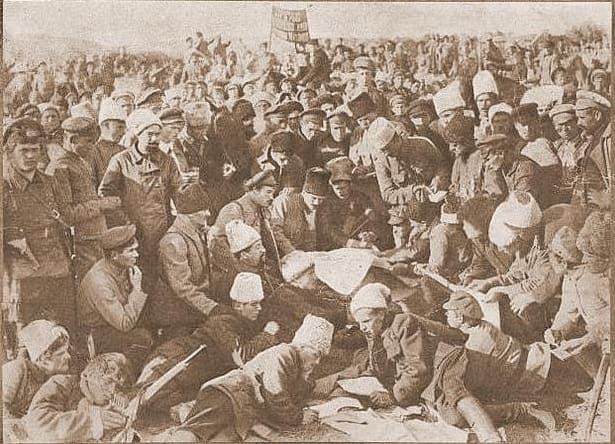
Featured image: Troops of Nestor Makhno’s Insurgent Army reading the terms of the draft Starobilsk agreement with the Bolshevik Ukrainian Soviet Socialist Republic – which only stood for a single month before the Bolsheviks resumed their attacks on the Makhnovists, whose actions had been instrumental in defeating the Whites in Ukraine.
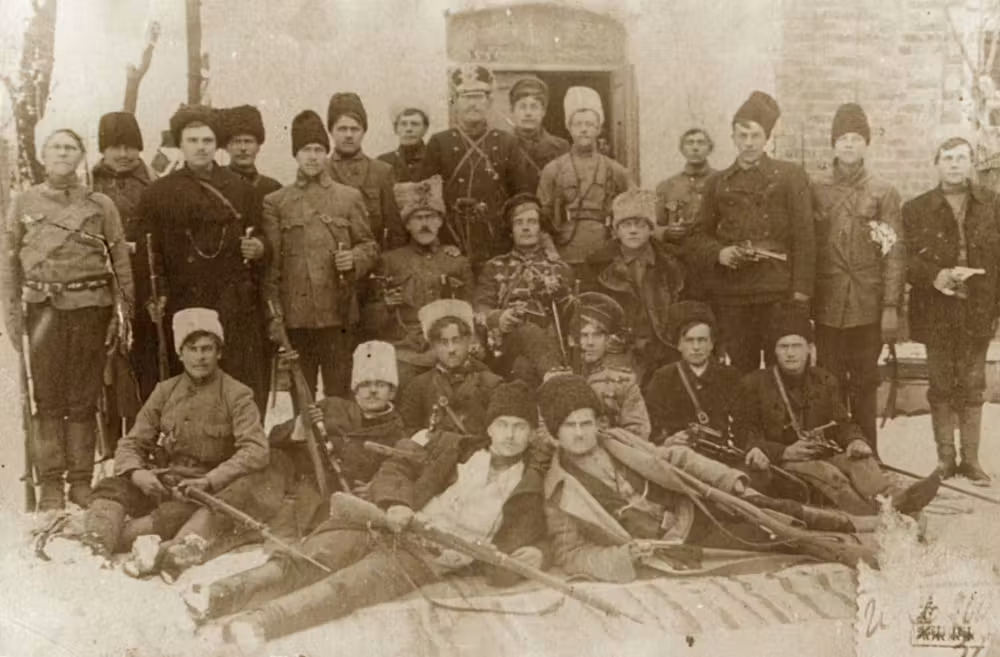
Other images are of Makhnovist fighters. Nestor Makhno himself appears in the first, left of center with long black hair obscuring his face.