AntiNote: What follows is a printable zine produced in the spring of 2026 by abolitionist participants in the resistance to Operation Metro Surge in Minneapolis/St. Paul, Minnesota, USA—while the wounds inflicted on local community by the fascist regime and their local accomplices were still very fresh.
We recently discovered that this important intervention had no digital home for wider distribution outside the Twin Cities metro, and present it here with the authors’ kind permission. Please feel free to print and share, wherever you are, to help combat the intentional misperception that local authorities somehow stood in opposition to the federal forces’ violent assault on Minnesota.
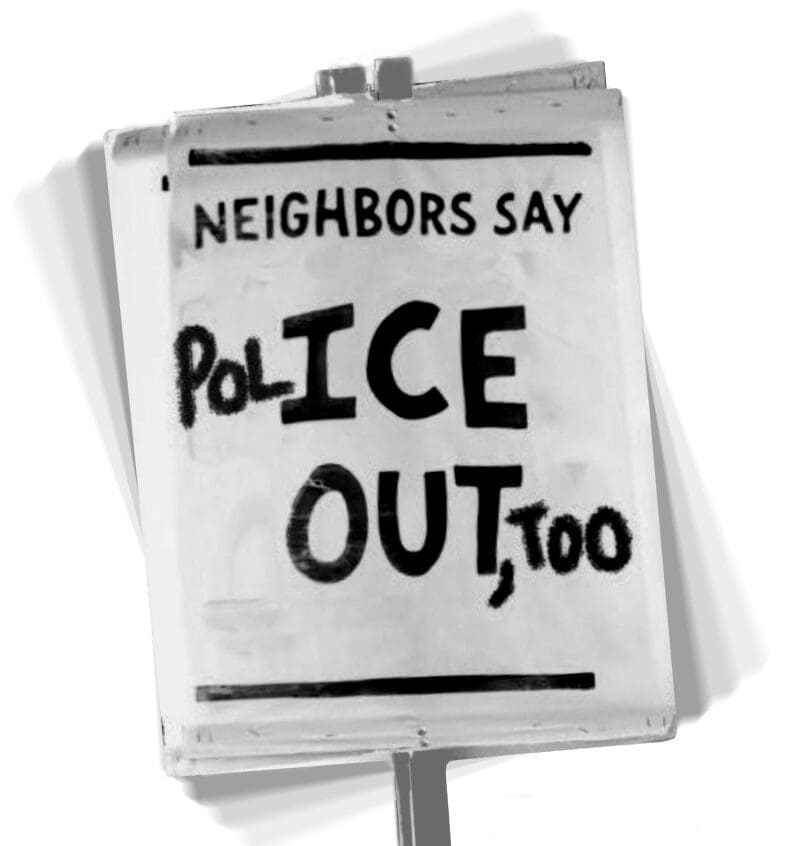
ICE-Police Collaboration in the Twin Cities
by some abolitionist activists
April 2026 (read | print)
A month after the supposed termination of Operation Metro Surge, locals take a look into the interactions between ICE and local law enforcement during the ICE invasion, deciphering the role that local authorities chose to adopt in a period of intense conflict and change.
PRELUDE
Back in early November 2025, before the ire of the federal immigration apparatus was focused directly on the Cities, I went to a “whistle training” in South Minneapolis. It was the second of two trainings put on by local organizers; the first bringing in over a hundred neighbors, with this one bringing in just over half of that. The gist was simple. Three short blows of a whistle meant that ICE was in the area, and three long blows meant that ICE was actively detaining someone.
After these instructions, the organizers separated us up into groups by neighborhood, giving all of us a series of scenarios. In each of them, one person would play the ICE agent, someone else would play a person being detained, and the rest of the group would play neighbors encountering the situation.
“So, who wants to be the ICE agent?” someone asked. The whole group chuckled, then everything was quiet for a moment. Even in a fake world, nobody wanted to be ICE. Yet after a couple more seconds of silence, my friend raised their hand. They would be the agent, and I would be a detainee.
I don’t exactly recall what the first scenario was. Maybe I was being taken away in a van, or maybe I was being arrested in broad daylight. Either way, the scene was set, and the rest of our group started to act just as they had been taught. Some blew fake whistles (as to not freak out real-life neighbors) and others shouted anything that came to mind in the moment:

That last one knocked me a bit out of my already poor performance. “The police? What were they going to do?” I asked myself for the rest of the exercise, before shuttering the thought as we grouped back up. We discussed how things went, and after a few comments, my friend spoke up. “One thing…” they started. “I remember someone saying something about calling the cops, and I just wanted to make it clear that the police are just as much our enemies as ICE is. They are not here to save us.”
The rest of the group nodded along, yet the man who made the initial statement seemed less convinced. I wanted to add something to the conversation—my friend’s conclusion seemed so obvious to me—but I couldn’t find the words. At that point, a lot was still up in the air. There was no telling for certain how the police would respond to a refashioned ICE entering the city, much less how they would respond to an invasion thousands of agents strong.
* * *
On 18 January 2026, Minneapolis police chief Brian O’Hara claimed that his emergency lines were “overwhelmed by people calling 911 to report ICE agents.” Over a month into Metro Surge, it was clear that people were scared, and that many were following their usual go-to in such a situation: calling the cops.
However, neither the Minneapolis Police Department nor the Saint Paul Police Department would intervene decisively in a single ICE kidnapping throughout the length of Trump’s campaign in the cities. In fact, what played out over those long two-and-a-half months served to show us a very different picture.
In the pages that follow, the duration of the recent ICE invasion has been chopped up into three discrete sections:
PHASE I: PRE-METRO SURGE
PHASE II: BOVINO-LED METRO SURGE
PHASE III: HOMAN-LED METRO SURGE
Each phase describes a different iteration of how law enforcement in the state of Minnesota responded to ICE, what actions they did and didn’t disrupt, and how their rhetoric shifted with shifting attitudes in the state. Though throughout them all there is one constant: ICE needs the police.
PHASE I: PRE-METRO SURGE
3 June 2025
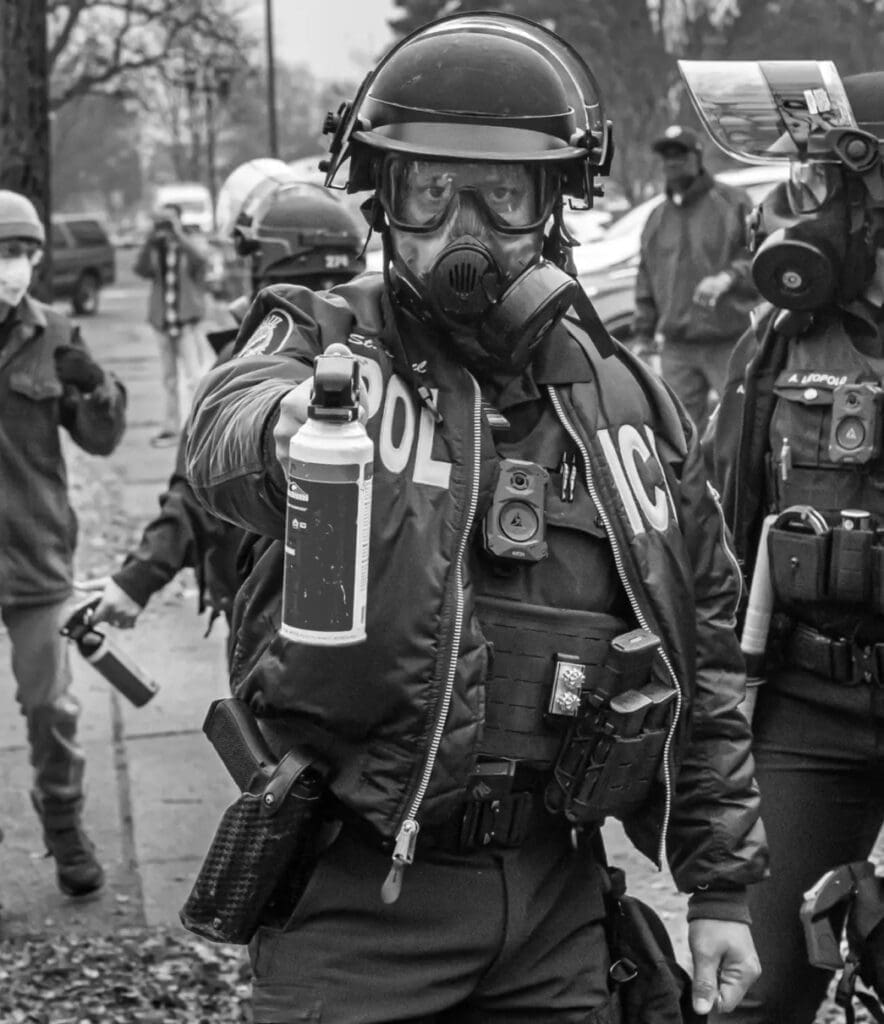
Dozens of federal agents (including ICE) raid a business in South Minneapolis, contested by a spontaneous crowd of up to two hundred protesters, some blocking federal vehicles. In response, feds shoot pepper balls and become violent. The Minneapolis Police Department (MPD) shows up to perform crowd control for the agents, and Hennepin County Sheriffs Officers (HCSO) deploy pepper balls and pepper spray on protesters as well. Mayor Frey claims, “Our police officers will not work to enforce federal immigration law; we will not be involved in federal immigration actions.”
18 November 2025
With support from the FBI and DEA, ICE performs a large-scale raid at the Bro-Tex facility in Saint Paul. A community response ensues, and responders are pepper-balled and sprayed by federal agents. There is no documented police presence. Mayor Carter claims, “Our officers will help de-escalate situations when possible.”
25 November 2025
On Saint Paul’s East Side, a community member flees an attempted ICE detainment, ending up in a home on the 600 block of Rose Avenue. At this location, ICE agents are confronted with dozens of community responders, who they target with chemical irritants, smoke canisters, and less-lethal rounds. The Saint Paul Police Department (SPPD) is called in to assist the agents, and deploys chemical munitions on responders in the process. The SPPD would later state, “Saint Paul police officers stood between protesters and federal agents, so federal agents could complete their legal objectives.”
Summary
LARGE RAID, LARGE RESPONSE
In the months before Metro Surge, ICE had not yet solidified the tactics they would rely on for the majority of the invasion. Their focus was on larger, staged raids, targeted towards the detainment of greater numbers of community members, such as the detainment of fourteen people at the Bro-Tex facility. This tactic was soon found to be unsustainable, as it was countered by the creation of NGO-sponsored hotlines, which would verify then disseminate updates about ICE activity to thousands across the cities, allowing for the large responses seen in cases such as those in Saint Paul.
With this infrastructure in place—and even before its implementation in the case of Minneapolis a year earlier—federal agents were forced to rely on local police forces when situations escalated beyond their control. And rely they did, the MPD securing them an exit route in June, and the SPPD guarding them as they performed their “duties” in November. These two actions would go on to set the tone for how local police would interface with the community going forward.
While the first instance in Minneapolis has not been confirmed as an immigration raid by government sources, in the weeks after, the MPD released a statement declaring that they were in compliance with the city ordinance preventing them from assisting ICE with immigration enforcement. Similarly, SPPD police chief Axel Henry referenced a near-identical city ordinance the same day he appeared on the scene to ensure ICE could carry out a deportation. Then, as if to subvert reality, he claimed the ordinance wasn’t violated by the day’s events!
Even before Metro Surge had begun in earnest, the limits of such city ordinances had already been breached. They couldn’t stop the cops from collaborating with ICE. Instead, they served to create a sort of “anti-ICE” mask, something to be put on for interviews, though not suitable for the street.
Still, this period of reality-bending could only last so long. The more ICE agents arrived, and the more unwilling the population became to put up with them, local law enforcement was made to change positions, both tactically and rhetorically.
PHASE II: BOVINO-LED METRO SURGE
4 December 2025
DHS announces Operation Metro Surge. [Four hundred, and later two thousand more] agents are sent to the Twin Cities to be led by Gregory Bovino, commander-at-large of the Border Patrol.
15 December 2025
ICE is surrounded by community responders in South Minneapolis. A woman is violently taken to the ground by an agent, while pepper balls, pepper spray, and tasers are deployed on community members. In response, some react by throwing rocks and ice. One ICE agent calls HCSO for backup, to which HCSO and MPD answer by clearing a path for the ICE agents to exit the situation.
7 January 2026
Renée Good is murdered by ICE agent Jonathan Ross in South Minneapolis. MPD appears at the scene with a Bearcat in full tactical gear as a crowd forms at the site of the murder. Tensions between the growing crowd and ICE increase while MPD attempts to clear ICE an escape route. MPD successfully opens a route for ICE to exit the situation, and a few community members rush to block the exiting ICE vehicles. MPD officers shove community members out of the way.
9 January 2026
Noise demonstrations kick off in downtown Minneapolis, with over a thousand people protesting outside two downtown hotels in which ICE agents are staying. Near the end of the night, an inter-agency police force composed of hundreds of state riot police, along with the Minnesota State Patrol and MPD, arrest thirty.
14 January 2026
Julio Sosa-Celis is shot and wounded by ICE in North Minneapolis. A crowd starts to form, confronting the federal agents, leading to the deployment of pepper balls, smoke grenades, and large amounts of tear gas. MPD arrives in riot gear, acting as reinforcements for the agents in their retreat—however, the MPD is eventually forced to retreat as well, deploying more tear gas, and firing projectiles at community members on their way out. The ICE vehicles abandoned are subsequently damaged and looted.
23 January 2026
Anti-ICE protesters block two of the exit points of the Whipple federal building (the Bishop Henry Whipple federal building has been used as ICE’s base of operations for the region, as well as an immigration detention center with repeated reports of inhumane conditions). ICE remains inside the building while HCSO comes out to defend the site, deploying tear gas on protesters. Two arrests are made.
24 January 2026
Alex Pretti is murdered by federal agents in South Minneapolis. Calls go out, and community members enter into the streets to confront the agents. Federal agents deploy tear gas, while MPD and State Patrol arrive to provide backup against the growing crowd. MPD shoots tear gas and rubber bullets at community members, announcing dispersal orders over Bearcat speakers. State troopers deploy more tear gas as well as flash-bangs. Dozens of community members are injured and many are arrested. The local and state police response allow for the federal agents to withdraw safely. Afterwards, MPD and the National Guard set up checkpoints in the neighborhood for the purpose of cutting off the flow of “materials for barricades or fires.”
26 January 2026
Gregory Bovino is removed as commander-at-large of the Border Patrol as well as the federal operation in Minneapolis. A noise demonstration draws a large group of protesters to the suburban hotel where Bovino is rumored to be staying. Border Patrol and the Maple Grove Police Department deploy tear gas and pepper balls on protesters. Two are arrested.
Summary
ICE MURDERERS, POLICE ACCOMPLICES
The beginning of Metro Surge marked an extreme escalation of federal tactics. At its highest point, it was estimated that at least 2,700 federal agents were stationed within the metro area, more than twice the size of the MPD and SPPD combined. In these numbers, they were impossible to ignore. If you lived in the cities, you saw it, your heard it, it was everywhere. All across town, rapid response chats exploded in size, streets were lined with commuters (the term that came into use to describe community members on ICE patrol using their vehicles), and there was hardly a window that didn’t contain some sort of anti-ICE propaganda.
All sectors of Twin Cities society oriented themselves against ICE—all but one, that is, though they would rather that fact go unattended. The police, in response to growing popular unrest alongside a gargantuan federal invasion, had to adapt once more. The large raids that had characterized the first phase of the invasion were no longer; they were too slow, too easy to disrupt, and they drew too much attention.
Instead, they broke up into smaller units, ants crawling all over the cities, detaining any person whose skin tone didn’t meet their fancy. And when they felt threatened, they exploded. Over the course of just three weeks, federal agents killed two and wounded one, each time sparking unrest from the surrounding area, and each time the MPD swooped in to save them from danger. If ICE was the administration’s sword, the MPD was its shield, defending it from all possible consequence, further emboldening agents on the ground.
This defense would continue as the population of the cities started to take things into their own hands. Hotel noise demonstrations became commonplace, as well as the police repression that followed. Yet, even as police continued enforcing “law and order” only on those in the battle against ICE, the noise demonstrations succeeded in pushing ICE officers out of the city. ICE was forced into the suburbs, further away from the cities’ denser population—this phase of the operation ending at a hotel in Maple Grove, around thirty miles away from the Whipple federal building.
Though popular mobilization would extend beyond noise demos. There were the rapid response networks of course—however, in perhaps the most demonstrative example of public opinion, around fifty thousand people marched in downtown Minneapolis on 23 January, participating in the so-called “general strike.”
It was within this paradigm that the rhetoric of local law enforcement shifted once again. MPD police chief Brian O’Hara made multiple public appearances, attempting to establish the line that the MPD has nothing to do with ICE operations in Minneapolis. He went on the record saying that he sees the invasions is “making people scared and terrified,” and in response to being shown footage of an ICE detainment he responded: “It pisses me off to see that, to see men doing that to a woman who’s disabled. It pisses me off.”
To this end, chief O’Hara came into somewhat of a superficial conflict with Tom Homan at the beginning of Metro Surge: Homan frustrated at the lack of O’Hara’s complete capitulation to his project, and O’Hara frustrated that Homan was undermining his credibility. O’Hara alludes to this in his New York Times interview after the killing of Renée Good:
Interviewer: If this escalates, are you worried that all of this will erase the work you’ve done over the years to rebuild and repair the community’s trust in the Minneapolis Police Department?
O’Hara: The number one priority that I worry about is erasing the gains that we have made rebuilding the department and being able to reduce crime in the city.
Likewise, Hennepin County sheriff Dawanna Witt shared similar concerns a week later:
Witt: We cannot let people in our communities think that our local law enforcement leadership is okay with the actions that we simply know are not just only wrong, but illegal.
Despite all the nice words about “the community” and “public safety,” law enforcement is concerned with a fundamentally different objective than the rest of us: retaining legitimacy. Even in their public appearances designed specifically to elicit support from the overwhelmingly anti-ICE public, their leaders cannot think beyond their own grip on power as they refuse to acknowledge their role in the perpetuation of ICE violence. They only wish for a continuation of “order,” continuing to seek an unreachable compromise between a fascist government and their antifascist constituency.
PHASE III: HOMAN-LED METRO SURGE
28 January 2026
A third noise demo begins at the Graduate Hotel on the University of Minnesota (U of M) campus due to its complicity in housing ICE officers. The hotel boards up its first floor windows, and after around two hours of noise, MPD, UMPD, conservation officers, and state troopers arrive, arresting sixty-seven.
30 January 2026
People protest outside of the Whipple federal building, demanding charges be dropped against twenty-two people given federal felonies in relation to the ICE invasion. HCSO deploys crowd control munitions on the protesters, detains several.
31 January 2026
Community members in South Minneapolis set up a “filter blockade” on two intersections on Cedar Avenue. After a few hours, multiple MPD squad cars arrived to harass participants, almost causing a traffic accident. MPD leaves the scene soon after.
2 February 2026
MPD officers clear one of the Cedar filter blockades as it was unattended. All items in the blockade were disposed of.
4 February 2026
Homan announces the withdrawal of seven hundred agents from the metro area.
5 February 2026
HCSO deputies assist ICE agents in detaining two people inside the Hennepin County Government Center. Both were detained before the completion of the case in which they were involved, an act claimed “unconstitutional” by chief public defender Mike Berger.
6 February 2026
A fourth noise demo begins at the Graduate Hotel. Twelve are arrested by a combination of state and local police officers.
7 February 2026
Community members across South Minneapolis raise filter blockades in order to create obstacles for the ICE invasion. MPD clears at least five blockades in the area, including one at Bloomington Avenue, where large numbers of MPD are deployed, including a SWAT team. There is one arrest.
A large anti-ICE protest coalesces at the Whipple federal building, in response to which HCSO calls in the State Patrol, leading to at least fifty arrests (twenty-five by state troopers). Minnesota Department of Transportation (MnDOT) snow plows are used by the state government to block points of entry to the Whipple building, obstructing ambulances from accessing the area.
9 February 2026
Another large protest at the Whipple building begins. Protesters throw hundreds of donated dildos at ICE vehicles while they pass by. In their defense, HCSO, state troopers, and conservation officers respond, chasing protesters before violently throwing them down against the asphalt, arresting up to fifty-four.
12 February 2026
Homan announces the “end” of Operation Metro Surge.
15 February 2026
Homan announces that over one thousand agents have already been withdrawn from the metro area, and that there were plans to withdraw hundreds more until the number reaches “pre-surge levels.”
1 March 2026
To mark the end of the “Melt the ICE Week of Action,” a mass march to the Whipple building is held. As the crowd neared its destination, HCSO and state troopers blocked the way, eventually rushing the crowd and tackling protesters to the ground, making up to thirty-nine arrests.
Summary
A NEWER NORMAL
After the arrival of “border czar” Tom Homan in the Twin Cities, there would be no more eruptions of mass unrest as there were under Bovino. Homan represented a more “civil” version of the Trump deportation machine. He didn’t wear a Nazi-esque coat like Bovino, and he didn’t go into the streets to throw tear gas canisters himself; he commanded from the backseat, content with lowering the temperature as long as the deportations continued.
And continue the deportations did, with recorded ICE sightings only consistently falling to pre-Metro Surge levels in late February. But this isn’t to say there wasn’t a change in strategy, the foremost of which was the shift towards the suburbs. Over the course of February, while total ICE sightings remained somewhat constant, the locations of such sightings became more and more concentrated in the outer rings of the metro area.
This had both advantages and disadvantages for ICE as a whole. On the upside (for them), the suburbs have a lower population density, and a less radicalized one at that. Due to this, rapid responders were often called in from more concentrated urban neighborhoods in order to help out immigrant communities in the suburbs, decreasing the overall concentration of rapid responders. However, on the downside, the decreased ICE concentration closer to the city made achieving arrests more difficult in the area, as can be seen by the decrease of arrests during this phase.
Still, this move created a different problem for those protesting against the ICE invasion. As known ICE hotels moved further and further away from the city center to places like Roger, Minnesota—partially due to hotels canceling ICE reservations as a result of public pressure—the crowds at the noise demos shrunk in size, and police repression at more centrally-located hotels such as the Graduate increased. Come February, it seemed like the hotel noise demos had reached their limit.
So the Twin Cities adapted, creating a new vector of resistance in the form of the filter blockades. These blockades consisted of anything from a couple people gathered in the middle of an already-existing roundabout on small streets, to makeshift roundabouts with fire barrels, old furniture, and wooden pallets, stopping cars with out-of-state plates as they crossed a midsize intersection. These blockades were effective in gathering community members in larger numbers to respond to ICE activity, becoming a general force repelling ICE from an area at a given time.
Tom Homan was very unhappy with this state of affairs. After the first weekend of filter blockades, he called MPD police chief O’Hara, saying that he “asked him to remove the blockades, and that the chief complied.” Later that day, Monday 2 February, the MPD would clear multiple filter blockades which had decreased in attendance as people went back to work.
The following weekend, the MPD would again heed Homan’s word, this time more forcefully, removing at least five filter blockades across Minneapolis, and in one case, deploying SWAT. After this point, the filter blockades would continue on some level, but without widespread adoption, became less of an effective anti-ICE tactic—the MPD again acting as a force to remove all possible barriers from ICE’s way.
In addition, another phenomenon was occurring at a broader scale with the “Block ICE Block Parties,” a similar but separate tactic that served to block off streets so that vulnerable families could leave their houses with lesser fear of ICE presence. These block parties began before and lasted longer than the filter blockades, though they did serve to inspire one another.
At first, the block parties received little police attention, and if they did, it was little more than warnings. However, after the Homan anti-filter blockade order, the block parties received more attention as well, including police harassment and dispersal of what amounted to little more than a neighborhood get-together. The police again serving as a tool to break up even the most non-confrontational anti-ICE community action.
This was the core of Homan’s strategy, obtaining maximal cooperation with local law enforcement so that:
- ICE could withdraw the minimum number of agents necessary to avoid the PR nightmare in which they had embroiled themselves.
- During this withdrawal, the deportations would continue in satisfactory numbers for the administration.
While point number one was quite obviously the reason for Homan’s arrival in the first place, evidenced by his quick removal of hundreds of agents from the Twin Cities, point number two passed somewhat under the radar. Though it wasn’t as if Homan was trying to hide it; in fact, he spoke of such goals openly during his first press conference in the cities, referring to a series of agreements he had come to with state officials and law enforcement.
These “agreements” were rather vague, and seemed to consist of already-existing relationships between state prisons and ICE framed as a next step, and new connections between Homan and local police chiefs. Overall, the conference gave the sense that DHS had lost the upper hand in the Twin Cities, and while the state attorney general decided to hold the line of “required” cooperation with ICE, the police chiefs would continue to follow Homan’s vision in the weeks to follow.
Until the very last days of Metro Surge, law enforcement suppressed any and all attempts at dissent from the community. Whether it was a hotel noise demo or a march on Whipple or a block party or filter blockade, or one of the hundreds of other encounters and altercations. When the police showed up, it was no question whose side they were on.
Without them, ICE would have had nobody to call in for backup.
Without them, ICE would have nobody to guard them as they slept.
Without them, ICE would have nobody to clear the streets for them.
Without them, ICE would have nobody to store people in cells for the taking.
Without the police, we wouldn’t be missing three thousand neighbors.