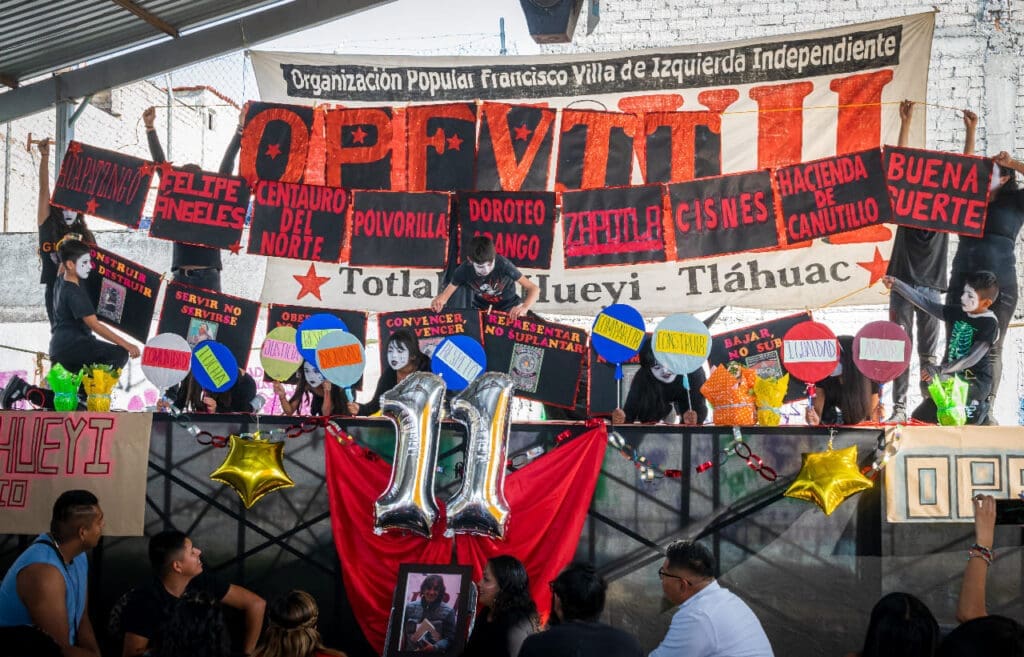
AntiNote (in English): In October 2022, revolutionaries from around the world gathered in Montreuil, a suburb of Paris, France, for the fourth edition of Les Peuples Veulent: a convening of activists, academics, and community builders who, in solidarity with the Syrian Revolution and other grassroots revolutionary struggles worldwide, came together to learn from one another and build solidarity across liberatory peoples’ movements. At this gathering, French organizers from the Comité de Solidarité avec les Peuples du Chiapas en Lutte (Committee in Solidarity with the Peoples of Chiapas in Struggle) interviewed David of the Organización Popular Francisco Villa de la Izquierda Independiente (referred to colloquially as “Los Panchos”), an autonomous community based out of Tláhuac, Iztapalapa, and Iztacalco in Mexico City. The interview was conducted in Spanish, with simultaneous translation into French, for CSPCL’s podcast, La Jungle des Luttes. Here we present a transcription of their interview in translated into English from Spanish.
Transcribed and printed with permission. Edited for space and readability. Listen to the whole interview:
La Jungle des Luttes: Thanks David for being with us. We’d love for you to introduce yourself and give us a bit of context about Los Panchos as an organization.
David: Hello to everyone who’s listening. Our organization, which we often refer to as Los Panchos, actually has a much a longer official name: the Francisco Villa Popular Organization of the Independent Left. This organization emerged in Mexico City thirty-five years ago. It’s an organization that’s based in the understanding that the need for proper housing is a unifying cause for many sectors of the population in Mexico City.
Since the foundation of the organization, we have approached our construction projects not just as a means to build housing but rather to build a dignified life for our communities. For us, a dignified life is not just about having a physical house – it’s also about having security, health care, culture, urban agriculture, processes of justice and accountability, and, of course, autonomously organized, community-managed infrastructure and governance.
So our priority is to build out communities in Mexico City. The difference between a colony and a community is that in the communities we inhabit, we produce and create everything that we need to live collectively and autonomously. How we work together in this organization is shaped by the intention of transforming existing relationships and ways of being in the City: we have established as foundational to our principles that we are working toward autonomy.
Usually in cities like Mexico City, autonomous self-organization is seen as unimaginable, because it’s widely believed that autonomy is something only the state or Indigenous peoples are granted. That being said, something we have achieved is that in our communities, we make decisions through our general assembly, our governance councils, and of course, majority rule. We work to build projects where we get to decide what we have to do and how we govern ourselves, including in processes of justice and accountability – the police are not allowed to enter into our communities, because we don’t believe in bourgeoisie justice. Accordingly, we have declared ourselves anti-capitalists and anti-imperialists.
To explain a little more about the organization itself: we have various administrative councils that oversee the life and well-being within each community. On one level we have our congress, where everyone who belongs to the organization and who wants to participate can do so, and they are free to propose ideas and tell the organization how they see things and how we should improve things in our community. This congress happens every two years. After the congress, our political committee meets, as they are responsible for the direction or rhythms between each congress. Another level of decision-making happens after the political committee, which is the general council of representatives. This council is usually composed of one or two participants of each committee, and the communities who have more than two hundred families living in them have to have three participants per committees for the council. It’s also worth noting that we have communities that inhabit three different boroughs of Mexico City: Tláhuac, Iztapalapa, and Iztacalco.
In total we have eight communities. We have a little over three thousand families living in them. So every one of these eight communities should have a council formed of at least eight representatives. The intention here is that these councils will return decision-making power to each community in absence of the political committee or political coordination. The councils are the ones that direct and implement plans for what kind of work needs to happen within each community.
Alongside these councils, we have our political coordination efforts, which are made up of comrades who have come up through political work, mass movement work, or community service work, and who have been invited to participate as leaders within each of these committees. We’ve always had eight committees in our communities, which are:
- The security committee, responsible for keeping watch for our community
- The logistics committee, which is in charge of self-administration
- The maintenance committee, which takes care of the communities
- The committee for culture, which is in charge of promoting culture in its broadest definition through workshops, political formation, film screenings and art shows, or through building out our popular education as a tool for transformation and developing our community members as critical thinkers and actors
- The committee for communications, which is in charge of putting on the Village Voices Radio, which broadcasts in Mexico City; they also coordinate all of the agitation and propaganda of the organization
- The urban agriculture committee, which is in charge of maintaining the urban gardens in addition to recuperating and cultivating love for the Earth amongst our communities
- The committee for sports, which is in charge of promoting events for physical and mental health in our communities; we believe that physical conditioning is important but we also believe in the value of mental agility, as well as a holistic and abundant mind-body connection
- The committee for health, which is in charge of building up promoters of health with the objective of preventing and treating illness, and finding alternative treatments for them; we are also able to ask for state subsidies and we can build our own clinics, which is ultimately the goal
In our last congress, since 2009, we integrated a few new committees:
- The finance committee, which is in charge of generating a process for building up a savings fund across our communities
- The children’s committees, because there have to be assemblies and committees for our youth to participate in and take ownership of within each community
- The committee for social gatherings for young people
Each community also has its own assembly, as well as the brigades: each community is divided into smaller groups to make the work more efficient.
So that’s a summary of Los Panchos. This is our structure, our governing bodies, and we do all of this work to build autonomously organized and self-managed communities in Mexico City.
JdL: Thank you so much David for giving us such a detailed outline of how life works in your community. Like we said in our introduction, we are the Committee in Solidarity with the People of Chiapas in Struggle, so we are trying to create a link here between Zapatismo and other struggles. So we wanted to ask what the link is between los Panchos and Zapatismo. We know that you all participated in the the campaign of the Sixth Declaration of the Selva Lacandona, so we’re hoping you could expand a bit more on that.
David: Yes, first off I’d like to start by saying that we have a lot of respect for Zapatismo in Mexico. Like you all said, we participated in their campaign [of the Sixth Declaration], and in fact their leader Subcomandante Marcos (who in that moment went by “el Galeano”) stayed with us for a few months during the repression following civil unrest in San Salvador de Atenco. He and his comrades were with us until about September of that year, while the campaign for the Sixth Declaration carried on making its rounds.
More recently we’ve been trying to work more closely with the National Indigenous Congress (CNI). We’ve supported the resistance in Amilcingo, for example, among other places. Some of the organizations that coordinate within the NIC are also collectives that we work with in Mexico City, so through that work we are weaving together a network of revolutionary organizations.
A while back we were invited to the Zapatista School, and in the last few weeks, right before arriving here in Paris, we participated in two mobilizations: one that was organized by the EZLN (Zapatista Army of National Liberation) to protest capitalist wars, and one that was organized by the National Indigenous Congress on the 12th of October to protest both capitalist wars and wars against Indigenous peoples. We will continue to participate in these calls to action because we are part of the Sixth Declaration of the Selva Lacondona, and because we believe in our comrades’ political analysis and want to show our support for them. It’s important to note that Indigenous peoples in Mexico, as well as autonomously organized communities in the cities and in all of Mexico are facing great repression and are being attacked by the state, which supposedly has leftist politics.
So to answer your question a little more concisely, we do always try to walk alongside our Zapatista comrades. And it’s worth mentioning that we’re often being asked if we are Zapatistas, but we aren’t – as our name suggests, we are Villistas. After the Mexican Revolution succeeded, Emiliano Zapata and Francisco Villa met in Xochimilco, very close to where Los Panchos live today. They signed an agreement there, the Pact of Xochimilco, where they committed to keep fighting together until their demands were met. In 2006, we signed the Sixth Declaration alongside the Zapatistas, and we continue to have this commitment to walk with them and to fight alongside them until our demands are met.
JdL: Thank you David. Could you talk a little bit about your personal trajectory in this movement?
David: I arrived at the organization with my parents. My parents were looking for housing in one of the largest cooperatives, which has 600 families. In these communities, each family belongs to a brigade and in each brigade people are selected to take on responsibilities and represent the group in the larger community. My parents were chosen to participate in the Maintenance Committee. In fact my parents are still on the Maintenance Committee, and they have been since 1998, pretty much to the date. So in that moment my mother, who hadn’t finished much of her studies, brought me to the committee meetings so that I could help her take notes for the committee. Before I knew it I became part of the committee as well.
In the year 2000, after all the culture-keeping work the organization had experimented with, the Committee of Education and Culture was formed. I’d also like to mention that it seems like we could be talking about a very long timeline here, but I am only 35 years old. So in 2000, we formed the culture committee and we began to build up everything that is now part of our culture and community rhythms – workshops about science, radio, cinema, popular education for the committees, and for me and other young people, I mean, when we were younger, in 2009, the organization proposed that we integrate ourselves into a more collective process. In the organizational congress in 2012 they gave us each a clear role and set of responsibilities and we integrated ourselves into the broader functioning of the organization. From that moment on, up until now, I’ve been responsible for the Committee on Health for the entire organization, and I’m also part of the Committee for Urban Agriculture for the whole organization. My other comrades from that time are now responsible for our projects on culture, communication, security, and so on. My dear comrade Rosario Hernández, who couldn’t be with us today for this interview, is also part of the political committee.
JdL: Would you tell us a little more about the Committee on Health and the Committee on Urban Agriculture?
David: The Committee on Health works the same as all of the other committees, which operates under three fundamental principles: science, culture, and political education. Everything we do in the committees, including in the Health Committee, has to be based in research: verifiable information and material terms with material explanations. This kind of process has to become part of our culture; it has to be integrated into the customs of our communities and into the daily lives of each and every family. With regards to our political education, everything that we propose and promote has to have a political lens. What emerges from these three fundamental principles is an attempt to create practical and concrete work, done with the intention of strengthening our communities.
In the case of the Health Commission, we have four fundamental principles, which are: preventative care, triaging, alternative or complementary medicine, and the creation of health care networks. To give one example, in the onset of COVID, our Health Committee spoke of COVID in preventative terms, which is to say, how it was transmitted, sharing all of the scientific information we had about COVID, in order to prevent it from spreading. This translated into workshops, talks, conferences, etc.
We worked with COVID through our line of triaging, but if we weren’t able to triage (as in, bring someone to the hospital), because in Mexico there wasn’t a lot of attention or care [around COVID], what we did was bring our sick community members to our own community’s Health Center, or we’d go to their homes, and our health care workers, with all the courage in the world, would attend to them, monitoring their vital signs, administering oxygen, giving them serums, and taking care of them according to the training we received from a doctor who was a comrade to us in that moment.
On alternative medicine, when it came to COVID, from the moment it started we launched a forestry school. We did this with the express purpose of sharing remedies made from medicinal plants, so we made tinctures, syrups, even oils so that we could relax when we were sick, things that would help us sustain ourselves and support us in staying a little more stable in that moment, which would complement other treatments, or would at times serve as a natural treatment.
In terms of weaving together networks for health care, it’s mostly understood that we get in touch with our master herbalist, who belongs to a Zapatista organization in Mexico, which is called the Zapatista Organization for the Liberation of our People; we have the doctor who helped us build our capacity around COVID, who is a node of solidarity that we have in Italy; and then our comrades in our communities organized a raffle, called Raffle for Life, so that we could pool our resources and stock our Health Centers with everything we needed, and we managed to buy oxygen tanks, compressors, everything our sick comrades needed in that moment. This is one of the many things that the Health Committee does.
In the Committee for Urban Agriculture, we have four objectives: recover our love for Mother Earth, humanize the capitalist processes, create and debate food sovereignty, and defend our natural resources and assets. So the Agriculture Committee investigates, shares with the community, and works to generate and present a political position about the plundering of our forests, our water, and our energy, which is happening at a large scale in this country.
When we talk about humanizing capitalist processes, we are not talking about making those processes more agreeable to us. We are referring to a political position we take to describe what’s happening all around us, and that we have normalized. For example: a little while ago, we gave a workshop to our young comrades in our community, and we asked them where chili peppers come from, and their answer was “the supermarket” or “out of the can.” That worried us, because we understood how urgently we needed to recover our love for the Earth, and we had to tell all of our young comrades that because we’re in a city, capitalism makes us lose sight of all of the natural processes that happen so that that chili pepper or that tomato could arrive at our table. So when we say “humanizing these processes,” it’s because in the big city, we are taught that it’s all very simple, and there’s nothing else to it beyond going to the supermarket, buying your cans of food, and heading on home – and that’s just not true.
We initiated a project after that workshop to bring our kids, our young comrades, to the garden, to learn from seed the processes of germinating, transplanting, sowing, everything we do in our gardens, with the intention of encouraging our younger comrades to understand what goes into our food arriving at our tables, and everything that happens before it arrives at the table – that there are large fields being sterilized by monoculture crops and fertilizers, which is also making a lot of people sick as a result.
So for us the Agriculture Committee is not just for our younger comrades, but for everyone who belongs to the organization. We want it to serve as a school, which would teach us all how to build out cold frames, green roofs, hydroponic projects, things that serve us to produce our own food in our homes, in an urban setting like Mexico City.
JdL: As a committee we have seen your communiques and we have disseminated them in the past few years – for example, I believe it was in 2020, you were denouncing a hostage situation that you had with a Colombian cartel. How do you organize your defense against these kinds of groups, like cartels, narcos, etc., and how do you organize your community defense in general?
David: Well first off, I want to mention that during that time where we were receiving threats in 2020, we were still able to keep working and stay active as an organization. Despite all the fear that the pandemic had instilled in us, it did allow for us to carry on our internal operations even as we faced the threats that this group of delinquents threw at us. Our ability to defend ourselves and protect our community primarily comes down to the control we have over our own territory. Our space is entirely enclosed. We are located at the outer limits of two boroughs – Iztapalapa and Tlahuac. So when we have any kind of crime or trouble in our area, if something happens, both boroughs will claim the other has responsibility for dealing with it, and ultimately neither will respond to the issue. So our assembly decided to delineate a boundary or perimeter around our community, since we are the ones permanently keeping guard in our neighborhood anyway. We set this up not just because of the threats we received but also just in general, in an everyday life kind of way: we have a community watch that runs 24/7.
The community in Acapatzingo, which is the community that received these threats, has 28 brigades. We have some comrades in that space who are expanding to a new plot of land out there, but we presented them with a provisional living space, so one arm of our guard works out there. We have 31 groups that each cover one day of the month to keep watch. Within the community, our guards are responsible for resolving day-to-day conflicts, in addition to making their regular rounds to keep watch. For example, it’s forbidden in all of our communities to drink alcohol in common areas. So as we make our daily rounds, if someone is found breaking this rule, we ask them to leave the community or to do so at home instead.
When we were threatened, our guard carried on as usual with their responsibilities, but they were also reinforced by all of our comrades who wanted to volunteer their time to provide extra back-up to defend our community. It’s worth mentioning that over 3500 people live in the community that was threatened, so when the threats came in, the number of people keeping watch reached up to 100 people per day. Because of these threats, we had a drastic increase in numbers for our guard for a long time – up until September of this year (2022).
I’d also like to clarify that we are at base a pacifist organization, but in that moment all of our communities were put on high alert to support whatever situation might arise. We worked to make it visible to our communities that, given how none of our local governments take responsibility for the safety of our neighborhoods, even though we don’t believe in the legitimacy of the state and much less its bourgeois justice system, we do consider them responsible for everything that happened in this area, because they are the ones that allowed for those delinquent groups to grow. So not only did we publish that report to keep our comrades and sibling organizations informed about what was happening, but we also let them know that the state and the Mexican government is allowing for these groups of criminals to terrorize their population.
Just to add one more detail, I wanted to say that our politicians don’t listen to us, and they are never going to guarantee us our safety, because they know we will never vote for them.
What we learned in that moment, which we have been learning for the past 35 years in this organization, is that sticking together and holding each other close is what keeps us safe. And so self-organization becomes in its own right a process that generates life, safety, and peace. Of course it scares us to be threatened like this, but staying united also helps us keep a handle on our fear, and instead channel that energy into organized actions. We take this very seriously: we will not risk the lives of any of our comrades. So when we were being threatened, the assemblies gathered and determined that we would defend ourselves, if that’s what it came down to.
JdL: On the topic of the government, what is your relationship with your government, and what do you think of AMLO’s (Andrés Manuel López Obrador) government in particular, which is supposedly leftist, despite imposing ever increasing militarization onto the territory and building our megaprojects all over the place?
David: In this moment the government is in its fourth transformation, so to speak. They present themselves as not being neoliberal, but to us they are, precisely for the reason you mentioned – all over this country these organizations have been co-opted and dismembered, activists have been assassinated, and communities have had their forests and waters stripped away from them. AMLO is presented as this figure who is looking after all sectors of the population, but that is just not true. The only thing he is doing is giving out grants – on the one hand he gives out money, and on the other he is contaminating and devastating the mangrove swamps, he’s giving over all the beaches to private initiatives, and the inappropriately named Tren Maya is going to devastate a large part of the jungle. And this is exactly what’s happening in the region of the Isthmus of Tehuantepec, robbing so many people of their land. One could say that for over 500 years the people continue to be dispossessed, and those very same people continue on with their resistance.
The state is building megaprojects like the airport, for which they gave over all of the construction and permits to the Secretariat of the Navy. A few weeks ago they launched an initiative where they asked the senate and the Chamber of Deputies to approve diverting the national guard’s forces to the naval secretariat, which to us means increasing how many soldiers we have policing our daily lives, and using military tactics to do so. If that’s not neoliberal, I don’t know what is.
All that is a continuation of the PRI (Institutional Revolutionary Party) of the eighties, where it was really the will of the president that governed us. Let’s not forget that Andrés Manuel was part of the PRI’s cabinets in the eighties. We can’t forget how the Mexican government signed off on plans like the Plan Puebla Panamá in the nineties, which was yet another step toward where we’ve arrived now, with our supposedly leftist government continuing to sign off on and pursue these age-old projects of turning the country over to privatization and profit-driven practices.
The same thing is happening in Mexico City. They are granting housing credits – salaries, essentially – to anyone who belongs to the ruling party (Morena) and to anyone whose vote they can count on. If you’re not loyal to the party, they don’t listen to you in this region. In our case, we’ll apply for subsidies from the Housing Institute of Mexico City, but given that there is a lot of speculation in Mexico City, the gentrification is extreme, so many people have been displaced to the peripheries of the city, and the whole city center is priced in dollars. So it’s true that we are fighting for our autonomy, but certain projects like building a house or apartment complex would take us many, many years to accomplish given the astronomical costs involved in that kind of project.
So what we do is use some of their laws to work in our favor – take, for example, housing laws in Mexico City. A while back we were granted loans to build out housing for one of our communities, and the Housing Institute mandated which contractors we had to work with to do these construction projects. It wasn’t an option to self-manage our construction projects because the owners of the companies that were registered with the Housing Institute were friends with the official who was in charge of these contracts at the Institute.
But a little while back the laws expanded to allow for self-managed construction projects to build housing in the city. That change allowed us to negotiate with the Institute: they had this new option, and we wanted to use it. The Housing Institute said yes, but you’re not a company, so we can lend you money under this new housing law, but we are going to give you 30% less of the loan than if you were hiring a private company.
To acquire the loan, we established ourselves as a legal entity in the form of a cooperative. The Francisco Villa Popular Organization of the Independent Left does not have a legal entity, so the legal entity we use are housing cooperatives. Everything we do in the Organization belongs to a cooperative, and within that cooperative, we fight for funding and resources. So we take the remaining 70% of the loan that they’ll grant us, and we have to build that housing ourselves. And through this project we have shown the state and the government of Mexico City that we can build our own housing, and it’s much better quality housing than what they have to offer.
Looking at this example, if they had given us 100% of that loan, and if we had used private contractors for the project, they would have built us 52 square meter housing units. Under our framework of self-management and autonomous production, even with the 30% cut they took from our credits, we built 64 to 67 square meter apartments. How did we manage this? Through communal work. We are the ones who sourced and brought in the materials, we transported everything we needed, and we saved on that labor, which is usually a big cost for construction. We were able to employ members of our community and the cooperative contracted with a number of construction workers, who are often from our community, and who were able to do this construction in a professional manner. We have a technical plan that we worked on with an architect, an engineer, and professionals who work with construction materials and who were able to direct us in how to use those materials. We took on the work of construction itself – this group of workers continues to be a part of our community. If I build my own house, I am going to build it well. Between all of us, we are able to ensure that we are using the right materials in the right ways for this project.
Returning to your question, the city government wasn’t able to say no to this kind of situation because we showed them that we built much better housing with fewer resources. We will always have to fight the city, but they can’t impose any kinds of infractions on us or link us to any kind of process of corruption because we built it ourselves and because that kind of corruption or mismanagement goes against our principles and is not part of our process.
The other thing they try to do is something that started in the eighties and nineties, which they called “citizenization,” which was designed to discourage people from organizing themselves within their communities, because the government was supposedly so kind, so leftist, so of the people, that you could just come and ask for housing, you don’t need to join any kind of organization. But that’s not true, and that’s never really worked for anyone. They keep trying to promote this concept of citizenization. So it’s worth explaining that we don’t have any kind of relationship with the government or the state alike, nor do we have any affiliation with the people of the Morena party in Mexico City – we don’t give them our votes, because we know that our existence means nothing to them, and they’d rather we didn’t. They haven’t been able to cut us off or deny us these credits because we’ve proven to them that we also use those resources well and our construction is far better than what they’ve got on offer.
So what we’ve ultimately tried to uphold is that our political struggle is always ongoing. We are always working to spread that political education and formation, remaining transparent and open about what’s happening in our communities, what’s working against us and against others, and how to resist those oppressive forces. It’s important that the community understands this siren song that the state has tried to ensnare us in is all an illusion – they are trying to deceive us, and they are marching us toward a series of processes that will destroy our territories and so much of what makes up the lives and livelihoods of our communities and ecosystems.
JdL: Thank you so much, David, this was a very rich discussion. Thanks again for your time.
Featured image source: OPFVII website