Transcribed from the 7 October 2026 episode of This is Hell! Radio (Chicago) and printed with permission. Edited for space and readability. Listen to the whole interview:
All these groups are being tied together to create a broader idea about the specter of what Trump calls “communism,” but really it’s anyone who believes we shouldn’t have concentration camps. It’s anybody who believes trans people should have rights, anybody who believes people who weren’t born here should be able to live here and live a good life.
Chuck Mertz: The Trump administration is corrupting and perverting the law to not only crack down on immigrants but on unions, the left, socialists, free speech, the right to protest, and political dissent. In that attack on our basic constitutional rights, the administration has brought hundreds and hundreds of cases—almost seven hundred now—against protesters who were lawfully exercising their constitutional rights, and hundreds and hundreds of dismissals prove that those attacks were political in nature and not grounded in the rule of law at all.
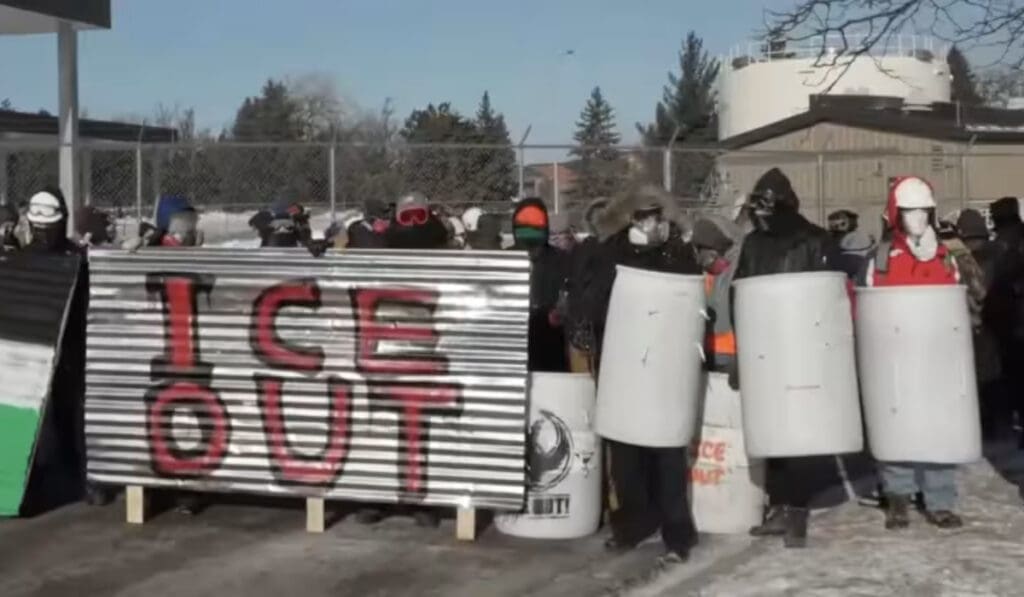
One of the many cases that exemplifies this politicization and weaponization of the law is the case of the Minnesota 15. We are very happy to have as our guest one of the members of the Minnesota 15, Cal Robinet, a union technician and activist. Cal is one of fifteen people in Minnesota who were recently federally indicted on felony conspiracy charges for their community activism during ICE’s deadly Operation Metro Surge immigration enforcement.
Welcome to This Is Hell!, Cal.
Cal Robinet: Hey, thanks for having me, Chuck. Glad I could be here.
CM: Thank you so much for being on the show. I saw your interview at Unicorn Riot, it’s fantastic.
As PBS News reported on the press conference announcing the arrests of the Minnesota 15, including you, back in mid-June, “Federal prosecutors have charged fifteen people with impeding the Trump administration’s massive immigration crackdown in Minnesota earlier this year, accusing them of coordinating efforts to block arrests and deportations as part of a conspiracy against the US government.”
Just to begin with: at the protests, did you or any of your colleagues impede ICE agents in their attempts to arrest those ICE alleged to be violating immigration law? And did you go to the protests with that intent?
CR: First I want to make a quick correction: we’re not being charged with impeding, we’re being charged with conspiracy to impede. This is an important legal distinction. A conspiracy is a legal construct that can be used to criminalize actions that are otherwise not criminal, and the administration is trying to create this legal construct to make normal, everyday activities appear as if they are impeding or intending to impede ICE officers.
At the advice of counsel, I can’t talk about specifically what’s in the indictment, but I can tell you if you and I were to have a conversation about how a vending machine works, and you were later to go try and steal a candy bar from a vending machine, now we’re both liable for that. Some of the things that we’re accused to have done, such as hold meetings, lead chants, or do legal observing—these actions are not illegal. But the federal government is trying to connections between us, in some cases that don’t even exist, to try and criminalize the whole community self-defense effort that happened in the Twin Cities.
We have a saying here that there’s fifteen of us in the courtroom, but it’s really the whole movement on trial, and people should be paying attention to this prosecutorial effort with the understanding that if they’re able to find us guilty, they’re able to find literally anybody guilty who makes a Facebook post or shows up to their local community food kitchen, or who even witnesses one of these violent, illegal abductions by masked paramilitary agents of the federal government in their city.
There are a lot of reasons this administration targeted Minneapolis. Our governor was the running mate of Trump’s political opponent, and he has openly said he is trying to get political retribution. But more important than that, our city was a target because of the George Floyd uprising and the community efforts that went into making our city a safer and more beautiful place to live back then. We were able to score a victory, and the far right is not okay with people not acting in line with authoritarianism.
This was never about undocumented immigration. We have less than two percent undocumented in our metro area. I want to make it clear that when they talk about “illegal activities,” this is purely a fictional construct of theirs. There is no such thing as “Antifa” as they describe it. To be antifascist is just to be human, and we are all human here, and we all see our neighbors and families and loved ones, and we don’t want to see any concentration camps in our city. That’s the one thing that they can’t stand about us.
CM: So this is conspiracy-to-impede; you were not impeding—the charges aren’t that you were impeding ICE officers, although PBS News reported it as such. That’s a very big difference, between committing a violent act and conspiring to commit a violent act.
How difficult is it to find someone guilty of conspiring to commit a violent act? In your process so far of being a defendant in this case, how difficult is that point to make by the prosecution? That would seem to be a difficult hurdle to jump when it comes to what’s legal.
CR: At the end of the day it all comes down to the jury, and what the jury understands to be the hurdle that needs to be cleared for any conduct to become part of a conspiracy. I will say that the actions of the Trump regime in the Twin Cities have been deeply unpopular; all throughout the state we have seen people taking very brave acts, of sheltering other human beings, of feeding and clothing other human beings, documenting the violence, the executions, the attempted killings of everyday people.
I personally believe that the prosecutors are going to have an uphill battle trying to convince a jury of our peers that what we did was illegal, or “terrorism.” If I were to make my own political point, it’s the executions in the street that are meant to cause terror, it’s not the people who are running toothpaste to the family sheltering in place.
CM: You mentioned earlier that this could be retaliation or retribution for the success of the protests following the police murder of George Floyd. You said the Minnesota activists scored a victory there. How well-organized is Minneapolis when it comes to responding to law enforcement abuses?
In February, we spoke with Michelle S. Phelps, author of The Minneapolis Reckoning: Race, Violence, and the Politics of Policing in America, and she explained that Minnesota and Minneapolis have a long history of fighting back against unlawful police violence that dates to long before George Floyd’s murder at the hands of police, and includes the police violence towards local Indigenous peoples and communities as well.
So is Minnesota or Minneapolis historically prepared for protests demanding justice for victims of police violence? And do you think that is another reason the Trump administration targeted Minnesota? Because Minneapolis has a very strong community activism culture?
CR: Yeah, I think that’s exactly right. I moved to the Twin Cities for college, and I never looked back. It seems to me that any time the state does something heinous, the Twin Cities shows up to defend ourselves and defend our neighbors. Every single time there has been a big blow-up—Jamar Clark, Marcus Golden, Philando Castile, Dolal Idd…I could go on naming names—more people get involved, more people see the truth about what’s happening with state violence and the nature of policing as a whole.
With the George Floyd uprising, we saw a massive shift away from this being a matter of activist networks, and it being a matter of the entire city. There wasn’t a whole lot of reporting about it, but I can tell you from firsthand experience that there was a lot of white supremacist violence happening in the Twin Cities during that uprising, and neighborhoods had to come together to make sure that their streets were safe. There were multiple attempted arsons, there were a couple of shootings—including one at one of my favorite Jamaican restaurants, where white supremacists decided to attack them. The horizontalist and anarchic nature of people working together not because someone is telling them to but because they see the commonality in the values they have—they understand what it means to be free people, and not to fall in line with authoritarianism and terror.
This is a tradition that stretches all the way back to resistance to settler colonialism, and you’re correct in pointing that out. The [site of the] concentration camp in our city, the Whipple federal building [at Fort Snelling], was originally built as a forward operating base for settler traders to disrupt Indigenous communities and economics in the early 1800s, and it was intentionally built at the confluence of the Minnesota and Mississippi rivers. Back then rivers were a massive hub for trading, because they didn’t have highways or railways.
Through that they were able to destabilize these networks enough in order to enact a genocide on the Dakota people, and they did that specifically at [Fort Snelling]. People may not understand that that building is often cited as an early modern example of a concentration camp in the 1860s—it was [where Dakota prisoners were held before] the largest mass execution in United States history [in Mankato, Minnesota], of thirty-eight Dakota men and two of their settler accomplices—and it’s being used as one again today.
That’s something we can’t forget: the history of colonial violence and the history of authoritarian violence are deeply intertwined. I forget who exactly said this, but fascism is colonialism brought home to roost. We’ve seen this here.
I’d also like to point out the history of the Teamsters strike in the thirties—the general strike and the conspiracy charges that followed that—as something that we’re reliving in many ways. There were twenty[-nine] people brought up on conspiracy charges in the forties for what happened in the 1930s; these were all unionists who the federal government was trying to throw under the bus for Minneapolis becoming a union town, effectively. Again, when we see the federal government attacking labor organizers—eleven of the fifteen of us have been labor organizers; eight of us are current and very active—it’s very telling what they see as a threat, who it is they’re trying to make an example out of.
It’s people who are able to talk to other people, who are able to organize with their neighbors and coworkers and their friends and family. They are coming after us for our speech, for our power that we have together—not for any illegal acts that we did.
CM: I appreciate the historic context you just offered. That is often something that is missing in news stories, especially when they’re trying to cover it in soundbite-size descriptions.
Cal, what do you think happens when that historic context is erased? How do we misunderstand what is taking place in Minneapolis when that history of the first concentration camp, of the largest mass execution in US history, the history of the general strike in the 1930s—how do we misunderstand what is happening today in Minneapolis without that historic context?
CR: I think this is intentionally-induced amnesia by authoritarian forces in our federal government, and just in our world today. A lot of people can’t stand the idea that people are able to organize themselves, people are able to see other human beings as human and work with them on a horizontalist level.
This is something that anarchists believe. I am an anarchist. An anarchist is somebody who takes democracy seriously. An anarchist is somebody who believes in freedom and thinks we don’t need anybody to tell us what to do, that we’re able to work amongst ourselves to find the best answers that better represent and respect the autonomy and well-being of others around us. This goes against the bottom-line model of profit-at-all-costs that the world has seemed to adopt.
Back in the fifties and the sixties, we saw a lot of forces in the federal government trying to co-opt horizontalist liberation movements by trying to draw them into the state, and especially over the last fifteen years we’ve seen this slash-and-burn approach to neoliberalism: to cut out social services, to privatize as much as possible, and to gut the safety net that people rely on, as this world needs to extract more and more from them.
This intentionally-induced amnesia, as a buddy of mine likes to call it, is done so that people can’t follow the same path that has been done before, of enacting social change, of doing protests and sit-ins and strikes and any creative actions towards building a better world. Thankfully, there’s been a lot of talk in the Twin Cities about these historical moments, and like [Mark Twain allegedly] said, history doesn’t repeat itself but it rhymes. A lot of this rhyming that we’re seeing—we had a local labor historian come speak at my local union meeting about retaliatory conspiracy charges for the general strike, and how that rhymes with what we have going on today.
I’m very thankful to everybody who’s been pointing this stuff out, and also thankful to you for giving me a platform to talk about it.
Unions as a structure have historically been, and need to be once again, organizations that defend at the workplace, defend in the community, and defend the class as a whole.
CM: We’re talking about the historical context and how that’s erased, but it’s not just the historical context, it’s recent developments—that context is often taken out of news coverage. For instance, you were talking about the white supremacist violence that was happening at the time of the George Floyd protests. This reminds me: dating back to 2015 in Portland, Oregon, the Proud Boys were organizing and attacking any Black Lives Matter or Movement for Black Lives or any type of protests that were happening in Portland at that time.
It seems like the news is not really interested in covering white supremacist violence. What do we miss in our understanding of what is taking place in Minnesota—or of all these protests in the wake of the murder of George Floyd; there was white supremacist violence in Kenosha as well that people were fighting against—what happens when that white supremacist violence is erased by the media?
CR: I have a buddy—shout out to Tariq Khan—who made a point in a book he wrote that the white supremacist mob has always been the bleeding edge of policy and social direction in the United States. A lot of times, those in power have used these mobs as ways to enact systems that continue to get them more power and build more authoritarian structures.
It’s really impressive the way people don’t talk about some of this stuff. I struggle to come up with a good answer for you about why that is, other than, Yeah, that’s messed up, they definitely do that all the time.
CM: When you were going to the protests for which you were later arrested as part of the Minnesota 15, did you believe you were going to stop an unconstitutional action, an illegal act? Did you believe that you were defending the law and law enforcement was undermining your rights?
CR: I think that’s an interesting way to look at it. My primary concern was always to protect people I love and care about. I wanted to make sure that no children got black-bagged at bus stops. I wanted to make sure that nobody got shot as they were trying to leave. I wanted to make sure nobody got gang-beat and pepper-sprayed. These masked paramilitary forces don’t like to be seen doing this kind of stuff. I saw the face of the devil out there this winter, and he will leave if enough people come to witness him.
My whole goal in the actions that I took over this winter was talking about what I saw, being out there witnessing this violence, talking to my coworkers—in my union local, we passed a resolution to allow stewards to shut down job sites if ICE is nearby, because that’s a safety issue. We’ve all seen the wanton and explosive violence when they’re trying to grab somebody, and three-quarters of people who ICE kidnapped have no criminal record at all, including immigration records. This was always a campaign of white supremacist terror, and we need to make sure that is pointed out: that this was a campaign designed to shock and pacify, not a campaign to do any kind of actual law enforcement.
The letter of the law as it is written—these ICE officers certainly broke it many times. The majority of the local federal prosecutor’s office quit during Operation Metro Surge because they witnessed the continual lying, and that evidence did not support the things ICE officers were saying. We saw on video two executions, one near-execution, and one shooting. One of the ICE officers involved in the shooting on the Northside that a man survived—our governor was in an extradition battle with the governor of Texas to try and find this man, but he is here now and is going to face trial.
But it would be a mistake to solely classify the action in the Twin Cities as about law. To me it’s always been about humanity. It’s always been about freedom. It’s always been about care and love. When people ask me the general question of what Metro Surge was like, I have a really hard time describing the weight of living through an ethnic cleansing. I have a very hard time using any words that don’t sound religious. I’m not a particularly religious person, I was raised Catholic. But I can tell you for certain when somebody dies and St. Peter asks them, What did you do during the ethnic cleansing?—I will have an answer, and I hope everybody else who lives here has one as well. I know that many, many of us did.
In the general strike, we had a hundred thousand people march downtown in negative-twenty-degree weather. The number of people who participated in some way, according to an interfaith poll by ISAIAH, was three hundred and eighty thousand. I wouldn’t be surprised if the number of people who participated in the community self-defense effort was nearly a million. We’re approaching half the people here. I don’t have a good source for that number, but based on how I experienced it as somebody whose job requires them to drive around to a lot of different locations—it was an entire metro under siege, and that was not a fact that was lost on the people who live here.
CM: You are a union activist and labor organizer. Why were you protesting for the rights of immigrants? We’re told by the right that all immigrants do is take away jobs from Americans. What is the connection between labor rights and immigrant rights? Why, as a union activist, do you think it is important to protect the rights of immigrants?
CR: We’ve always had this saying in the labor movement: An injury to one is an injury to all. There’s been a horrible mistake in the trend since the Reagan era that a labor union is something that just exists at work, a labor union is just for contract management and dispute negotiations. All of these things are important, but labor organizations, ever since the late 1800s, have always been community organizations. They’ve always been working class organizations.
It’s an incredibly recent and historically-induced amnesia to believe in that. When we talk about respecting the rights of the most vulnerable in our society, we often just think about people out living their lives, and not when they’re on the clock. We spend a third of our entire lives at work, and it’s important to recognize that people deserve respect and care, and to not be mistreated while they’re on the clock as well. This goes down to things like the right to express who they are, whether that be their culture or language or if they’re queer in some way, or if they have different ways of thinking about how to do work, ways that may be more efficient, more collaborative, more horizontal.
But also, I feel like I’ve got to point out that the largest amount of theft that happens in this country is wage theft, followed by [civil asset forfeiture]. Unions as a structure have historically been, and need to be once again, organizations that defend at the workplace, defend in the community, and defend the class as a whole. Because we recognize the amount of damage that the ruling class and the billionaires have been inflicting on this whole world, and it’s up to us—the poor, the dispossessed, the racialized, the queer—who don’t have systemic and structural power to work together as a working class to be able to put up a defense, for people to have the ability to live their lives.
This is something that it’s really important for our unions to take on.
CM: “Treasure Thoreson is a special education teacher who is among those indicted. [Eleven of the fifteen] defendants in the Minnesota 15 are union members, and many are leaders in their locals. […] She built on her strike experience as she began to organize against ICE in her neighborhood, working with a group of rank-and-file union members called the Workers Solidarity Circle.”
This is according to an article at Waging Nonviolence. As you were pointing out, it’s not a crackdown on immigration, it’s a crackdown on organizing—on labor organizing, on political organizing, on people power. It’s a crackdown on community organizing. Thoreson is also quoted, saying of the charges, “This is purely a way to try and send a message of fear and of repression.”
Has this slowed or undermined organizing in Minnesota? Did this cause a culture of fear and repression to the point that it did become a major obstacle to organizing in Minnesota?
CR: Shout out to Treasure, she’s my homegirl, I love her very much. We worked together in the Workers Solidarity Circle project.
It’s very silly in so many ways—after the general strike, the very next day ICE executed Alex Pretti in the street, and then the day after that, sixty Minnesota CEOs sent an open letter to the regime telling them they need to de-escalate the situation because it’s affecting their profits. Being able to drive this wedge in the ruling class was a very important tool for us in the Twin Cities to stop this terror.
At its peak, there were nearly four thousand agents here, that you could just see walking down the streets in body armor with assault rifles. After these couple incidents with the community defending itself, we saw the drawdown. Governor Walz cut a deal with Homan, and Bovino was shown the door. Another historically-induced amnesia: that guy is out on the explicitly white supremacist talking circuit in Europe right now. People don’t talk about that. That is the man who was leading [Border Patrol] at the time.
But Walz struck this deal with Homan, and we’re not entirely sure what was in it, but we’ve noticed a couple things. Number one is that there’s a lot more collaboration between local and federal forces right now, with the local police doing their dirty work for them, and they sent Border Patrol tactical units packing. Number two is that we’ve seen an uptick in activity at night and in rural areas, which are things that we didn’t see as much before. And number three is that we’ve seen ICE collaborating with jails more frequently, so they can pick people up when they’re released from jail.
There’s only a couple counties in Minnesota that allow ICE to go directly into a jail, but as a workaround, cutting a deal with the regime, now we see them picking people up as they’re released from jail. Recently there was another article about ICE agents releasing people and then different ICE agents immediately picking them up again, as a way to reset the timer and keep people indefinitely detained in camps.
But after that denouement—we saw all these ICE agents leaving; ninety percent of the four thousand of them left, there are still four hundred. That’s still ridiculous; there were thirty before this whole thing started, which is still too many. There should be zero. We saw all this die down, we saw the shock-and-awe doctrine lay low. To be honest with you, a lot of the energy around this anti-ICE stuff was at a low point, because you couldn’t just walk down the street and see military equipment—but then they decided to raid my house.
It’s going to be up to us, up to the people, up to the unions. It’s going to be up to the faith organizations and community groups, every knitting club, every Dungeons & Dragons group, every girlies-going-clubbing text loop. We’ve all got to be involved and stay involved, because that’s what’s going to be able to out-organize the authoritarian state.
I saw one helicopter; I heard an ICE agent say there were multiple helicopters. To pick me up—just me. This retributive action that they took really reignited the whole Twin Cities, and we’re seeing every community organization, every labor organization, every faith organization turning up for the Minnesota 15. We just had a march that was partially led by the AFL that had more than a dozen unions sign on. My father is a retired teacher upstate, and he was at the yearly retirees’ first-day-of-school Ha-ha-we-don’t-have-to-go-to-school-anymore party, and he had coworkers who were talking about the Minnesota 15 not knowing that I was one of them.
This is everywhere. These very unwise individuals kicked a hornet’s nest in the Twin Cities, and they’re seeing once again what it means to try and take on a city that’s mobilized, that’s organized, that cares about its neighbors. We’re unique in the Twin Cities, but we’re not special. Every city can be organized like this; everybody can make these kinds of connections. I would encourage people who see this and want to contribute: just get out there in your neighborhood. Talk to people in your life, talk to people at work, talk to people at church. This is something that we’re all going to have to take on together, and I mean that very large, collectively: all.
This isn’t just about the Twin Cities, this isn’t just about Operation Metro Surge. This is a fight between the ruling class and their Epstein associates, and the rest of us who are out here in the cold. We need to make sure people understand that and people are ready to face the storm ahead. We didn’t pick this fight, the regime picked this fight because they needed a scapegoat for problems that they can’t resolve—they can’t resolve them while continuing to harm and kill and exploit us here in the United States and people around the globe. They just want to take more and more, and they’ve pushed people too far. We’re here standing up for humanity.
CM: A week before that press conference in mid-June and the arrests of twelve of the Minnesota 15, we spoke with Lauren Fadiman, who posted the Baffler essay “The Invention of Antifa: The courts decree a new domestic terrorist” about the Prairieland detention facility protesters. According to the New York Times, “The charges provoked instant outrage from a broad coalition of civil liberties advocates, leftists, and other critics of the Trump administration, who rejected the government’s argument as not only wrong but dangerous, a chilling attack on the free speech rights of every American.”
Do you believe the Minnesota 15 and the Prairieland 9, and the Broadview 6 who we may touch on later, are victims of a conspiracy by the Trump administration to silence free speech and constitutionally-protected political dissent? Is the bigger conspiracy the one the Minnesota 15 were engaged in to protect immigrant rights, or the one the Trump administration is, in silencing free speech?
CR: The National Security Presidential Memorandum 7, the designation of “Antifa” as a leftwing terror organization, is really telling with regard to the kinds of targets they are making out of those who oppose their campaigns of terror. All these groups are being tied together to create a broader idea about the specter of what Trump calls “communism,” but really it’s anyone who believes we shouldn’t have concentration camps. It’s anybody who believes trans people should have rights, anybody who believes people who weren’t born here should be able to live here and live a good life.
This memorandum directing the justice department to prosecute Trump’s political enemies and try to create a conspiracy out of us is one that’s going to have to be met head-on. As of Monday, it was announced there is a new group called the NSPM-7 Defendants Union, where people who have been involved in these high-profile cases can come together to share what’s happening to them, the ways they’ve been talking about it, and the legal strategies that we can use to push back on this overreach, this explicitly political prosecution.
There was a time in this country when we had rules against such things, but it seems like the bill of rights isn’t really a thing that is being applied anymore. I look forward to connecting more with some of these other [City Name] [Number of People] teams, because we’re certainly not the last one. I hear that there may be more charges coming down the line for people in Texas right now, and all kinds of rumors floating around about what may be happening next.
CM: I’m sure you’ve been following these other trials closely. In the case in Prairieland, the jury found Benjamin Song guilty of attempted murder and he was given a one-hundred-year sentence. Other people in the Prairieland group were sentenced to thirty to seventy years in prison. Now ballistics evidence seems to show that Benjamin Song did not shoot or attempt murder of the police officer, that he was shooting a warning shot at the ground. But that was not presented at trial.
In retrospect many believe that the Prairieland defense team appeared far too confident in their case, and underestimated the quality of the prosecutors’ case, at least in how the jury reacted. As you mentioned at the beginning of our conversation, it’s always up to the jury.
Do you have concerns about overconfidence in your case, or an underestimation of the impact the prosecutors’ case could have on a jury?
CR: A lot of people, especially experts in the legal field, tend to take a very narrow view about what makes a strong legal case, presuming regularity: The government has this evidence and it’s going to bring this evidence, and this is about actions that were allegedly committed. But the reality is that with political cases like this, you have to defend them in a political context. That’s part of the reason that people in the Minnesota 15 have been out here talking about our case over and over, and I really appreciate you and everybody else who’s been putting us on, to give people the opportunity to build an understanding about the reality of what it is like to live through a political prosecution like this.
I personally believe that the case against us is extremely weak, but the legal construct of conspiracy is extremely strong. I believe that the people of Minnesota are strongly united in their understanding of what it is that actually happened here, and it only takes one dissenter to have charges not stick. At the same time, I also understand that we’re living in a moment of growing authoritarianism in the United States, and it may be the case that it’s simply not possible to win cases like this anymore. If that’s the truth about what’s happening right now, then I’m here to tell you everybody should pay attention to that and take note.
I am accused of doing very little in contribution to this fake conspiracy, and the reason they’re going after me is that they don’t like my speech, my organizing; they don’t like the books I’ve written. They don’t like who my friends are, that I’m queer, that I help run a house of trans refuge. They don’t like these things. This is a type of political understanding that is key to mounting an affirmative defense in a way that the Prairieland case did not. My heart goes out to all those who got the book thrown at them; the judge made a bunch of really irregular decisions in that case, and the defense chose not to mount an affirmative defense, feeling like they had simply disproven the prosecutor’s case well enough.
We need to be loud and present; we need to be in our communities talking about this stuff. Not just those accused, but those on the defense team, those on counsel, those in the media, those in our community, those in our workplaces and unions, faith communities, everyone. Everyone needs to be talking about it.
CM: The local NBC affiliate here in Chicago reported last week that “Federal judge Alice Perry is considering whether to appoint a special prosecutor to investigate potential misconduct in the Broadview 6 case by the US attorney’s office. Perry told prosecutors she would be issuing a list of evidence that US attorney Andrew Boutros and his team must turn over that could shed more light on how prosecutors mishandled the Broadview 6 case, to the point they had to drop all charges. Specifically, Perry seemed intent on finding out whether Boutros and his team were acting on orders from outside the office, referring to the Trump department of justice, and whether those orders were to carry out a politically-motivated prosecution.”
So Cal, how much faith do you have in Minnesota’s courts to protect your rights from politically-motivated prosecution?
CR: The NSPM-7 as a whole is a directive to politically-motivated prosecution. It’s kind of ridiculous that we’re even entertaining the idea that this isn’t. As an anarchist, I don’t believe in lobbying and begging, I don’t believe the mechanisms of the state have our best interests in mind at the end of the day. I believe in organizing, in people power, and I believe in the ability to exert pressure through people power to make sure that we avoid these kinds of miscarriages of justice that we’ve seen in other places in the country.
The federal prosecutors are going to have an extremely uphill battle in this case, and we’ve seen already the prosecutor Sommer Honeycutt make mistake after mistake, not understanding how the structure of a trial works, introducing evidence and citing cases that don’t support her arguments, not even knowing some of the things that she had filed. We understand that Brian Lynch, the January 6er who is a higher-up in the justice department, has appointed a new prosecutor to our case recently. Looking forward to seeing the best and brightest that the justice department has, because it’s been a little embarrassing for them, I will say.
I’ve enjoyed the clown show, it’s been quite entertaining. But I feel like now with enough media attention and understanding about this trial, the justice department is scrambling to not be embarrassed in the way they have been already, and we’ll see where this goes.
CM: Cal, I’ve got one last question for you, but it’s a two-parter. The final question is always the Question from Hell, the question we hate to ask, you might hate to answer, or our audience will hate your response.
What do you believe will happen to political dissent and free speech in the United States if you are found guilty? And do you believe that if you are found guilty, the next incoming Democratic administration would free you, release you and all your co-defendants, and pardon all your charges?
CR: This history is yet to be written. I’m done reading the tea leaves on what’s going to happen here; I’ve been shocked at every turn by the ridiculousness, the brutality, the inanity, the ways this world has moved along in the last fifteen years, but especially the last two. I don’t believe the Democratic Party is going to be able to mount any kind of affirmative defense here. I hope they are, but I don’t expect that they are.
It’s going to be up to us, up to the people, up to the unions. It’s going to be up to the faith organizations and community groups, every knitting club, every Dungeons & Dragons group, every girlies-going-clubbing text loop. We’ve all got to be involved and stay involved, because that’s what’s going to be able to out-organize the authoritarian state.
If it is that we are found guilty of conspiracy to impede, people need to recognize and adapt their tactics of community self-defense to this new moment. I can’t tell you what that might look like, it’ll look different in different places. But people need to be brave, continue acting within their power—not lobbying, not begging, not just art projects, but to exert pressure for justice wherever they can.
This is my belief as an anarchist and somebody who believes we can have a better world.
CM: Cal, I cannot thank you enough for being on the show. It’s been a pleasure talking to you.
CR: Thanks, Chuck.
Featured image source: Black Cat Workers Collective